 services@aitchsoft.com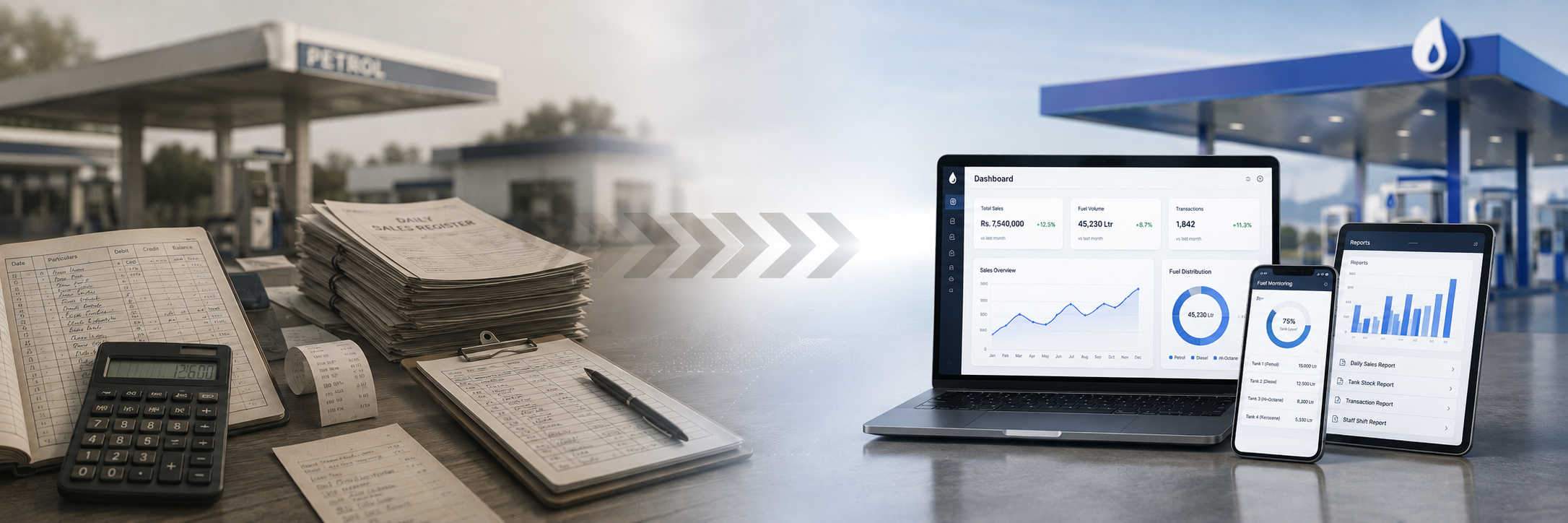
Introduction:
A customer drives into a petrol pump, fills the tank, pays, and leaves. From the outside, it looks like a business that should be easy to manage.
But what happens after that customer leaves?
Someone has to record the nozzle reading. Someone has to make sure the litres sold match the amount of fuel that should be missing from the tank. Someone has to check how much cash came in, how much was sold on credit, how much fuel was bought, and whether the numbers match at the end of the shift.
Now imagine doing this every day for hundreds of customers, several fuel pumps, different products, shifts, expenses, credit sales, and stock.
Suddenly, running a petrol pump does not look so simple.
For many petrol pump owners in Pakistan, the daily routine has traditionally depended on a familiar set of tools: a register, a calculator, a pen, and eventually an Excel file. These tools worked because they solved the immediate problem. A manager could write down the readings, calculate fuel sales, record expenses, and prepare a report at the end of the day.
But there is a difference between recording a business and managing a business.
A register can tell you what someone wrote down. An Excel sheet can calculate what you entered. But neither automatically tells you that yesterday's stock does not match today's sales, that an expense has been entered incorrectly, or that a particular shift deserves closer attention.
And as a petrol pump grows, these small problems can become expensive.
A few litres missing from one shift may not seem important. A small calculation mistake may go unnoticed. A delayed report may not feel serious. But when the same problems happen repeatedly, across hundreds of transactions, they can quietly affect the business's cash flow, stock control, and profitability.
This is why petrol pump management has been changing.
The shift did not happen overnight. First came paper records. Then Excel made calculations faster and reduced some of the manual work. Later, specialized petrol pump software began bringing sales, stock, expenses, credit, and reporting into one system.
And now, cloud-based platforms and mobile apps are making it possible for owners and managers to access important business information without being physically present at the pump.
This is not just a technology trend.
The wider fuel industry has already been moving in this direction. Pakistan State Oil, for example, introduced its Total Retail Automation Programme across about 1,400 New Vision retail outlets, connecting forecourt equipment with point-of-sale terminals to reduce manual intervention, errors, and pilferage.
The reason is simple: the more information a petrol pump produces, the harder it becomes to manage that information manually.
Today's petrol pump is no longer dealing with only fuel sales. It may have multiple nozzles, several employees and shifts, fuel purchases, inventory, expenses, supplier payments, customer credit, cash transactions, and daily reports—all generating information that needs to be accurate and available at the right time.
That is where digital management becomes more than a convenient alternative to a register.
A modern petrol pump management system can turn those scattered transactions into information that an owner can actually use. Instead of asking an employee to find yesterday's figures in a register or Excel file, the owner can see the business in a more connected way.
And the smartphone has pushed this change even further.
The biggest shift is from recording information after something happens to having information available as the operation happens.
This is especially relevant in Pakistan. In April 2026, reporting around OGRA's real-time digital dashboard highlighted concerns about weak retail data reporting from more than 12,000 petrol pumps, with the dashboard intended to improve visibility into supply, sales, and stock levels.
The question is no longer simply whether a petrol pump should move from paper to Excel, or from Excel to software. The bigger question is what the owner can do when the business's important information is available in one place, updated regularly, and accessible from anywhere.
That is the real evolution of petrol pump management
A 2026 scoping review examined 13 peer-reviewed studies published between 2015 and 2024 to understand how digital technology is changing fuel-service businesses. The research looked at areas such as customer interaction, automation, business intelligence, and data-driven decision-making.
Paper helped petrol pumps keep records. Excel helped them calculate. Software helped them connect the operation. Mobile technology is helping owners see the business wherever they are.
And once you understand this journey, it becomes easier to see why petrol pump management is moving away from registers and scattered spreadsheets—and toward systems that do more than record what happened. They help owners understand what is happening, where problems are appearing, and what needs attention next.
Chapter 1: Before Excel, There Was the Register
Before there was petrol pump software, mobile apps, dashboards, or even Excel, there was the register.
For years, a petrol pump's most important business information lived on paper. Behind the counter or inside the manager's office, a simple register recorded the numbers that kept the station running. A pen, a calculator, and an experienced manager were often all that was needed.
At the start of a shift, the opening nozzle readings were written down. Throughout the day, fuel was sold and payments were collected. When the shift ended, the closing readings were recorded. The difference between the two readings showed how many litres had been sold.
Then the manager had to make sense of everything else.
Cash sales had to be recorded. Expenses had to be written down. Fuel purchases had to be entered. Stock had to be checked. Credit customers had to be tracked. Employee shifts had to be recorded. At the end of the day, these numbers had to come together to give the owner an idea of what had happened at the petrol pump.
It was a simple system, but it worked.
The register did not need an internet connection, electricity, software installation, or technical training. Every employee understood where to write a number. Every manager knew how to read the pages. If the owner wanted to check the day's business, the register was sitting right there in the office.
For a small petrol pump, that was enough.
In fact, calling the register an inefficient system would miss the point. It was designed for the size and pace of the business at the time. When transactions were manageable and records were limited, writing things down and calculating them by hand was practical.
The problem appeared when the business became more complicated.
A petrol pump could have multiple nozzles selling different types of fuel, several employees working different shifts, regular fuel deliveries, growing expenses, credit customers, supplier payments, and hundreds of transactions passing through the station. Every additional activity created another number that someone had to record, calculate, and check.
And paper has a limit.
A handwritten mistake can be difficult to find. A missed entry can affect the calculations that follow. A damaged or missing page can mean losing valuable information. Even when every number is recorded correctly, someone still has to calculate the totals and prepare the reports.
More importantly, the information remained trapped inside the register.
An owner sitting at home could not simply open the day's records. If they wanted to know how much fuel was sold during the morning shift, how much cash was collected, or whether expenses had increased, they usually had to call the station and ask someone to check the register.
The business was becoming more complex, but the method of managing it had not changed.
That created a new problem: the petrol pump was producing more information than a paper register could comfortably handle.
This is where the next major change began.
Excel offered something the register could not: the ability to calculate, organize, and change large amounts of information without doing every calculation by hand. Instead of writing numbers on a page and reaching for a calculator every time, managers could enter readings into a petrol pump management Excel sheet, use formulas to calculate litres and sales, and keep records in a structured digital file.
For many petrol pumps, this was a major step forward.
The register had made it possible to record the business.
Excel made it possible to calculate the business more efficiently.
But that distinction would become important. Because once petrol pumps started putting more of their information into spreadsheets, they discovered another problem: calculating numbers was only one part of managing the operation.
And that would eventually lead to the next stage of the journey—from Excel to dedicated petrol pump management software.
Chapter 2: Excel Changed Everything
The register had done its job. But as petrol pumps grew busier, managers started dealing with more numbers than they could comfortably handle on paper.
Then Excel entered the picture.
For a petrol pump owner who had spent years working with handwritten registers, Excel offered something completely different. The business itself stayed the same. Customers still arrived, attendants still filled their tanks, and managers still checked the day's sales.
But now, the manager could put those numbers into a computer and let Excel do the hard part.
The calculations.
Take a simple example. A nozzle records 250 litres of petrol sold. The manager needs to multiply those 250 litres by the current fuel price to calculate the sales amount.
With a register, the manager reaches for a calculator, does the calculation, and writes down the result.
With Excel, the manager enters the litres and price into the sheet, and a formula calculates the amount.
That difference may sound small, but multiply it by dozens of calculations every day and the benefit becomes obvious.
Excel could add daily sales, calculate fuel totals, track expenses, and prepare monthly figures without forcing the manager to repeat the same calculations again and again. If the manager changed a figure, Excel could update the related totals automatically.
For petrol pump operators, this felt like a major improvement.
Instead of filling page after page in a register, they could open a workbook and see rows, columns, formulas, and totals in one place.
That led to the rise of the petrol pump management Excel sheet.
A manager could create columns for opening nozzle readings, closing readings, litres sold, fuel prices, sales, expenses, and cash. They could create another sheet for fuel purchases and another for stock. They could keep customer credit in one section and staff shifts in another.
The best part was the flexibility.
The owner did not need to buy a specialized system or hire a developer. If the petrol pump needed a new column, the manager could add one. If the owner wanted a monthly total, they could create a formula. If they wanted to keep another type of record, they could create another sheet.
Excel adapted to the petrol pump instead of forcing the petrol pump to adapt to the software.
That explains why Excel became such an important step in the evolution of petrol pump management.
But Excel solved one problem while leaving another one untouched.
It made calculations easier. It did not make the entire operation automatic.
Someone still had to read the nozzle.
Someone still had to enter the reading.
Someone still had to record expenses.
Someone still had to check the cash.
And someone still had to make sure the numbers actually matched what happened at the petrol pump.
Excel could calculate 10,000 litres perfectly. But if an employee entered 1,000 instead of 10,000, the spreadsheet would happily calculate the wrong answer.
That is the difference between a calculator and a management system.
Excel could process the information that people gave it, but people still controlled the process.
At first, that did not seem like a serious problem. A small petrol pump might have one computer, one main workbook, and a manager who knew exactly how everything worked.
But then the business grew.
The sales sheet became bigger. The expense sheet gained more entries. Fuel purchases needed their own records. Stock required regular updates. Staff shifts added more information. Credit customers created another set of transactions.
One workbook became several sheets.
Several sheets became a complicated workbook.
And eventually, different employees might keep different copies of the same file.
Now the manager had a new problem.
Which file contains the latest numbers?
This was the point where Excel started to show its limits.
The spreadsheet had replaced the paper register, but the manager still had to maintain it. The computer had replaced the calculator, but the business still depended on manual data entry. The records had become digital, but they still lived inside files that someone had to organize, update, protect, and share.
And if the owner left the petrol pump, the information usually stayed behind on the office computer.
That mattered more as petrol pump owners started expecting faster answers.
They did not just want to know how much fuel they sold yesterday. They wanted to know what was happening today.
They wanted to compare shifts. They wanted to check the stock. They wanted to review expenses. They wanted to understand sales without waiting for someone at the station to open an Excel file and send them the numbers.
Excel had taken petrol pump management a long way.
It moved the industry from paper calculations to digital calculations.
But the next step required something more.
The industry needed a system that could connect the different parts of the business instead of making the manager connect them manually.
And that is where dedicated petrol pump management software entered the story.
Era | Main technology | What it solved |
Paper | Register + calculator | Recording transactions |
Excel | Spreadsheet + formulas | Faster calculations |
Software | Petrol-pump management system | Connecting operations |
Cloud | Centralized online data | Access from anywhere |
Mobile | Smartphone app | Management on the go |
IoT | Connected equipment | Automatic data collection |
AI | Analytics + prediction | Understanding and predicting problems |
Future station | Integrated mobility platform | Fuel + EV + retail + services |
Chapter 3: But Excel Had a Problem
Excel solved the problem of paper, but it created a new problem that became harder to ignore as the petrol pump grew.
The information stayed in the file.
And the file usually stayed on one computer.
That sounds harmless until the owner needs an answer when he is not at the petrol pump.
Imagine the owner is away from the station. He is visiting a supplier, handling another business, or sitting at home. He suddenly wants to know:
“How much did we sell today?”
It should take a few seconds to answer a question like that.
But with a traditional Excel setup, it can turn into a phone call.
The owner calls the manager.
“Open the Excel file and check today's sales.”
The manager goes to the office computer, opens the folder, and starts looking for the right file.
Then he finds three versions:
Petrol Pump Sales August.xlsx
Petrol Pump Sales August Final.xlsx
Petrol Pump Sales August Final 2.xlsx
Now the question has changed.
The owner no longer asks, “How much did we sell?”
He asks:
“Which file is the correct one?”
That is where the real problem begins.
The manager may have updated one file while the accountant updated another. Someone may have sent yesterday's version through WhatsApp. Another employee may have saved a copy on a laptop. The owner may have an older file in his email.
The business now has digital records, but nobody has a reliable single source of truth.
Office computer → Laptop → USB → WhatsApp → Email
Everything looks digital.
The workflow is still manual.
The Problem Isn't Excel. It's the Way the Business Uses It.
Excel itself isn't the enemy.
A well-designed spreadsheet can calculate sales, organize records, and save a manager hours of manual work. For a small operation, it can still do a perfectly reasonable job.
The problem starts when the petrol pump asks Excel to do something it was never designed to do: act as the entire management system for a growing business.
Think about what happens during a normal day.
An employee takes a nozzle reading.
The manager writes it down.
Someone enters it into Excel.
The accountant checks the figures.
The owner asks for an update.
Someone opens the computer.
Someone sends the file.
Someone checks the numbers.
Every step depends on a person doing something correctly and passing the information to the next person.
That creates room for problems.
Someone can enter the wrong reading.
Someone can forget to update a sheet.
Someone can overwrite a formula.
Someone can use an old version of the workbook.
Someone can forget to back up the file.
And sometimes nothing goes wrong at all—the information is simply not available when the owner needs it.
That last problem matters more than it first appears.
A Business Owner Shouldn't Have to Chase His Own Numbers
A petrol pump owner shouldn't need to call three people to find out today's sales.
He shouldn't have to ask an employee to open a computer just to check a shift.
He shouldn't have to wait for the accountant to prepare a spreadsheet before he can understand what happened at the station.
And he shouldn't have to wonder whether the number someone sent him came from the latest file.
The owner doesn't really care about the Excel workbook.
He cares about the information inside it.
He wants to know how much fuel the pump sold.
He wants to compare today's sales with previous days.
He wants to see what happened during each shift.
He wants to know how much stock moved.
He wants to track expenses and credit.
He wants to see whether the cash and sales make sense.
Most importantly, he wants those answers without chasing people or files.
That changes the question completely.
The question is no longer:
“How can I create a better Excel sheet?”
It becomes:
“How can I make my petrol pump's information available when I need it?”
The Solution: Put the Business in One Connected System
This is where dedicated petrol pump management software changes the equation.
Instead of keeping sales in one spreadsheet, expenses in another, stock somewhere else, and reports on someone's computer, a management system can bring those parts together.
The employee records the transaction.
The system stores the information.
The manager can review the operation.
The owner can see the relevant reports.
Everyone works from the same data instead of passing different copies of the same Excel file around.
That creates something Excel struggles to provide:
one connected source of information.
Now the owner doesn't need to ask, “Which file should I open?”
He can simply check the system.
If he wants today's sales, he checks today's sales.
If he wants shift performance, he checks the shift report.
If he wants fuel stock, he checks the stock records.
If he wants expenses, he checks the expense report.
The information no longer depends on one computer sitting inside the petrol pump office.
And that leads to an even bigger change.
Once the business stores its information in a connected, cloud-based system, the owner doesn't necessarily need to sit at the petrol pump to see it.
He can check it from another computer.
Or from a tablet.
Or from the device that almost every business owner already carries in his pocket.
The smartphone.
That is the real solution to the problem Excel exposed.
The goal isn't simply to replace one spreadsheet with another piece of software.
The goal is to remove the constant movement of information between people, files, computers, and messages and replace it with a system where the business keeps its information together.
Excel made petrol pump records digital.
Connected software makes those records useful.
And once that information becomes accessible from a smartphone, petrol pump management starts to move beyond the office—and into the owner's hands.
Chapter 4: What Can You Actually Manage From Your Phone?
Now let's get practical.
What does “managing your petrol pump from your phone” actually mean?
It doesn't mean your smartphone is going to run the pumps for you.
Your employees still have to do their jobs. Fuel still has to be delivered. Customers still have to be served.
What changes is how you handle the information behind all of that.
Fuel Sales
You can keep track of the fuel sales being recorded by the station instead of relying on scattered notes or different spreadsheets.
Pump Tanks and Nozzle Readings
Opening and closing readings are a normal part of daily petrol pump operations. Recording them digitally gives you a structured record instead of another handwritten entry to keep track of.
Expenses
Fuel sales are only one side of the business.
There are always expenses.
When those expenses are recorded in one place, it becomes easier to understand where the money is going.
Staff and Shifts: Employees
A petrol pump doesn't run on one person.
There are managers, attendants, cashiers, and different shifts. Keeping shift information organized can make the daily handover much easier to follow.
Customers and Credit
If your station deals with customers on credit, those transactions also need somewhere reliable to live.
Instead of searching through notebooks or old sheets, digital records can keep the information organized.
Inventory
You need to know what is coming into the station and what is going out.
Fuel inventory is therefore another important part of the bigger picture.
Reports
And finally, there are reports.
Because at the end of the day, you don't really want hundreds of individual numbers.
You want answers.
How did we perform today?
What happened during the Employees shift
What changed compared with yesterday?
That's where organized digital records become useful.
Chapter 5: Meet Pump Manager
This brings us to the reason AitchSoft built Pump Manager.
The idea started with a simple question:
Why should managing a petrol pump require sitting in front of a computer?
If the owner is already carrying a smartphone everywhere, why shouldn't petrol pump management be designed around that reality?
That's the thinking behind Pump Manager.
Instead of asking petrol pump owners to build another complicated Excel workbook, the aim is to give them a dedicated place to manage their petrol pump records through a mobile experience.
Depending on the features available in the application, that can include areas such as sales, pump readings, expenses, staff, customers, inventory, reports, and other parts of daily management.
But the bigger idea is much simpler.
You shouldn't have to spend your day thinking about where a file is.
You should be thinking about your business.
You shouldn't always have to call someone just to find out what happened.
You should be able to access the information you need.
And you shouldn't have to be sitting inside the petrol pump office to stay connected with your operation.
That's the idea behind Pump Manager.
You can explore the app and its approach to petrol pump management at pumpmanager.org
Conclusion:
Petrol pump management has come a long way. Owners once depended on registers and calculators, then moved to Excel for faster calculations and better records. Dedicated software connected sales, stock, expenses, staff, and reporting, while cloud and mobile technology made business information available from almost anywhere. Now, automation, real-time data, and AI are opening the next stage. The goal is no longer just to record what happened at the petrol pump. Owners need to understand what is happening, spot problems quickly, and make better decisions. From paper to smart technology, the future of petrol pump management is about turning everyday business data into useful information.
References
- ScienceDirect / Procedia Computer Science (2026). [Title of the scoping review on the fuel service ecosystem].The study reviewed 13 peer-reviewed articles published between 2015 and 2024 and identified five themes in fuel-service digital transformation: digital customer interaction, operational optimization, innovative infrastructure, market intelligence, and sustainable service strategies.
- Business Recorder (2026, April 7). OGRA dashboard activation urged amid weak fuel retail data reporting. The report states that weak retail data reporting from more than 12,000 petrol pumps was limiting real-time monitoring of supply, sales, and stock levels, and that OGRA's digital dashboard was intended to provide real-time visibility across the fuel supply chain.
Frequently Asked Questions
1. How was petrol pump management done before Excel?
Petrol pumps traditionally relied on paper registers, handwritten records, and calculators to track nozzle readings, fuel sales, expenses, stock, credit, and daily transactions.
2. Why did petrol pumps start using Excel?
Excel made calculations faster and helped managers organize larger amounts of information. They could use formulas to calculate fuel sales, totals, expenses, and other daily figures without doing every calculation manually.
3. What are the limitations of using Excel for petrol pump management?
Excel still depends heavily on manual data entry and file management. Multiple file versions, incorrect entries, missing backups, and limited access outside the office can make management difficult as the petrol pump grows.
4. What is petrol pump management software?
Petrol pump management software is a system designed specifically to help manage operations such as fuel sales, nozzle readings, stock, expenses, credit customers, staff shifts, and business reports in one place.
5. Why is petrol pump software better than Excel?
Excel mainly helps you organize and calculate data, while dedicated software can connect different parts of the petrol pump operation. It can reduce repetitive work and give managers a more organized view of the business.
6. Can I manage a petrol pump from my smartphone?
Yes. Mobile and cloud-based petrol pump management systems can allow owners and managers to access business information from a smartphone, depending on the features of the software.
7. What can a petrol pump management app track?
Depending on the app, it can track fuel sales, nozzle readings, stock, purchases, expenses, credit transactions, employees salaries, cash, and reports.
8. What is the future of petrol pump management?
The industry is moving toward cloud systems, mobile management, real-time data, automation, connected equipment, digital payments, and AI-powered analytics..
9. Is Excel still useful for petrol pump management?
Yes. Excel can still work well for small operations or basic record keeping. However, as the number of transactions, employees, products, and records increases, a dedicated management system can provide a more connected approach.
10. What is the difference between a petrol pump app and petrol pump software?
A petrol pump app usually focuses on mobile access and management, while petrol pump software can refer to a broader management system that may include desktop, web, cloud, POS, inventory, reporting, and mobile features.
11. Why is real-time information important for petrol pump owners?
Real-time information helps owners see what is happening at the station without waiting for employees to prepare reports or send spreadsheets. It can help them respond faster to changes in sales, stock, expenses, and daily operations.