 services@aitchsoft.com
“Why build two separate apps when one codebase can power them all?” This question is rapidly reshaping the modern mobile app industry as businesses search for faster, smarter, and more cost-effective ways to reach users across multiple platforms.
In today’s competitive digital market, companies are expected to deliver high-performance applications for both iOS and Android without increasing development time or operational costs. As a result, cross-platform app development has become one of the fastest-growing approaches in the software industry.
The demand for cross-platform apps continues to rise because businesses want efficiency without compromising user experience. Instead of maintaining separate teams for Android and iOS development, organizations now prefer frameworks that allow developers to write a single codebase and deploy it across multiple platforms.
This approach reduces development expenses, accelerates updates, and ensures consistency in design and functionality. For example, startups developing delivery, e-commerce, or healthcare applications can launch products more quickly while managing fewer technical complexities.
Several global applications have already demonstrated the effectiveness of cross-platform technologies. Apps like Instagram and Alibaba have shown how businesses can scale their services efficiently while maintaining strong performance and user engagement. This growing adoption highlights how cross-platform development is no longer just an alternative approach but a strategic business decision.
Among the leading frameworks driving this transformation are .NET MAUI and Flutter. Developed by Microsoft and Google respectively, both technologies aim to simplify app development while offering modern performance and scalable solutions. However, each framework follows a different architecture, development philosophy, and business approach.
This article explores the growing importance of cross-platform app development and provides a detailed comparison between .NET MAUI and Flutter, including their performance, UI capabilities, scalability, development experience, and real-world business applications.
What is .NET MAUI?
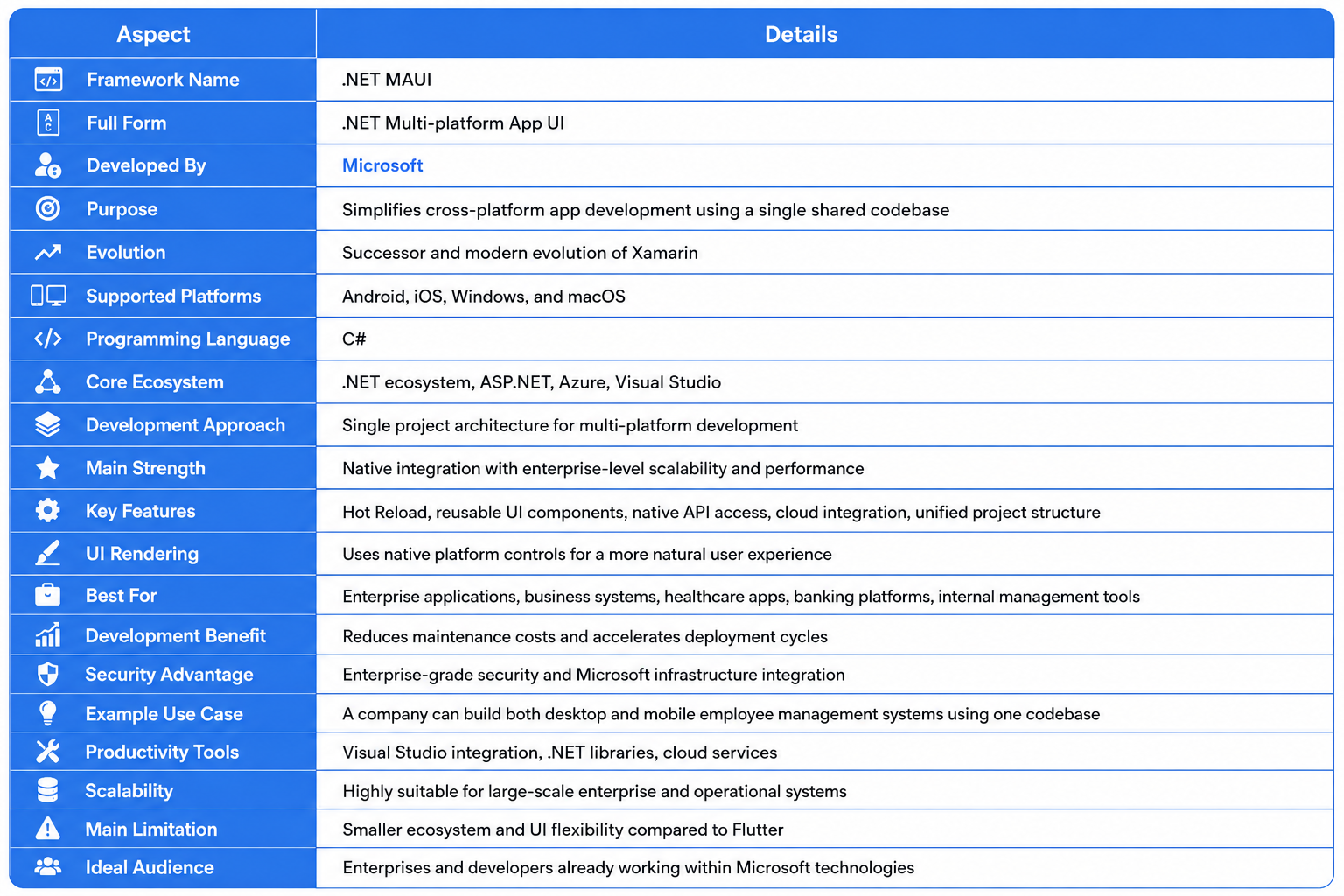
As businesses continue shifting toward cross-platform app development, the demand for frameworks that combine performance, scalability, and development efficiency has grown rapidly. One of the strongest contenders in this space is .NET MAUI, a modern framework developed by Microsoft to simplify the process of building applications for multiple platforms using a single codebase.
.NET MAUI, which stands for “Multi-platform App UI,” is the evolution of Xamarin, a framework that previously allowed developers to create Android and iOS applications using C#. While Xamarin was widely adopted for enterprise mobile applications, it faced limitations in UI consistency and project management complexity. Microsoft introduced .NET MAUI as the next-generation solution to overcome these challenges and unify mobile and desktop app development under the modern .NET ecosystem.
The framework enables developers to build applications for Android, iOS, Windows, and macOS from a single shared codebase. Unlike traditional native development, where separate programming languages and environments are required for each platform, .NET MAUI streamlines development by allowing teams to work within one unified architecture. This reduces maintenance efforts, accelerates deployment cycles, and improves collaboration among development teams.
One of the biggest strengths of .NET MAUI is its deep integration with the C# and .NET ecosystem. Developers familiar with C#, ASP.NET, or enterprise-level Microsoft technologies can transition smoothly into mobile and desktop app development without learning entirely new languages. This integration also provides access to powerful tools such as Visual Studio, .NET libraries, cloud services, and enterprise-grade security features. For organizations already using Microsoft technologies, .NET MAUI becomes a natural extension of their existing infrastructure.
The framework also includes several core features designed to improve both developer productivity and application performance, including:
- Single project structure for managing multiple platforms
- Native API access for platform-specific functionality
- Hot Reload support for faster UI testing
- Integration with cloud and enterprise services
- Reusable UI components across platforms
- High-performance rendering optimized for native experiences
A practical example of .NET MAUI’s capabilities can be seen in enterprise application modernization projects where businesses need to upgrade outdated cross-platform systems into scalable and maintainable solutions.
One example is the Pool Expert project, where an existing Xamarin-based application was migrated to .NET MAUI to improve performance, simplify maintenance, and align the platform with Microsoft’s modern .NET ecosystem. The project involved rebuilding the mobile application architecture while maintaining compatibility across Android and iOS devices through a single shared codebase.
The migration helped improve UI responsiveness, streamline development workflows, and reduce long-term maintenance complexity. Integration with ASP.NET Core services and cloud-based infrastructure also strengthened backend performance and scalability. This modernization demonstrated how .NET MAUI can help businesses transition from legacy mobile frameworks into future-ready enterprise solutions while maintaining strong native performance and long-term support.
For example, a company managing an internal employee management system can use .NET MAUI to build both desktop and mobile applications without maintaining separate development environments. Similarly, businesses developing banking, healthcare, logistics, or enterprise resource planning systems often prefer .NET MAUI because of its scalability, security, and compatibility with Microsoft enterprise solutions.
.NET MAUI is particularly well-suited for enterprise applications, productivity tools, business management systems, and applications that rely heavily on the Microsoft ecosystem. Companies already working with technologies such as Azure, ASP.NET, or SQL Server can benefit greatly from the framework’s seamless integration capabilities. While it may not yet have the same community size as Flutter, .NET MAUI continues to grow as a strong option for businesses seeking native performance with long-term enterprise support.
What is Flutter?
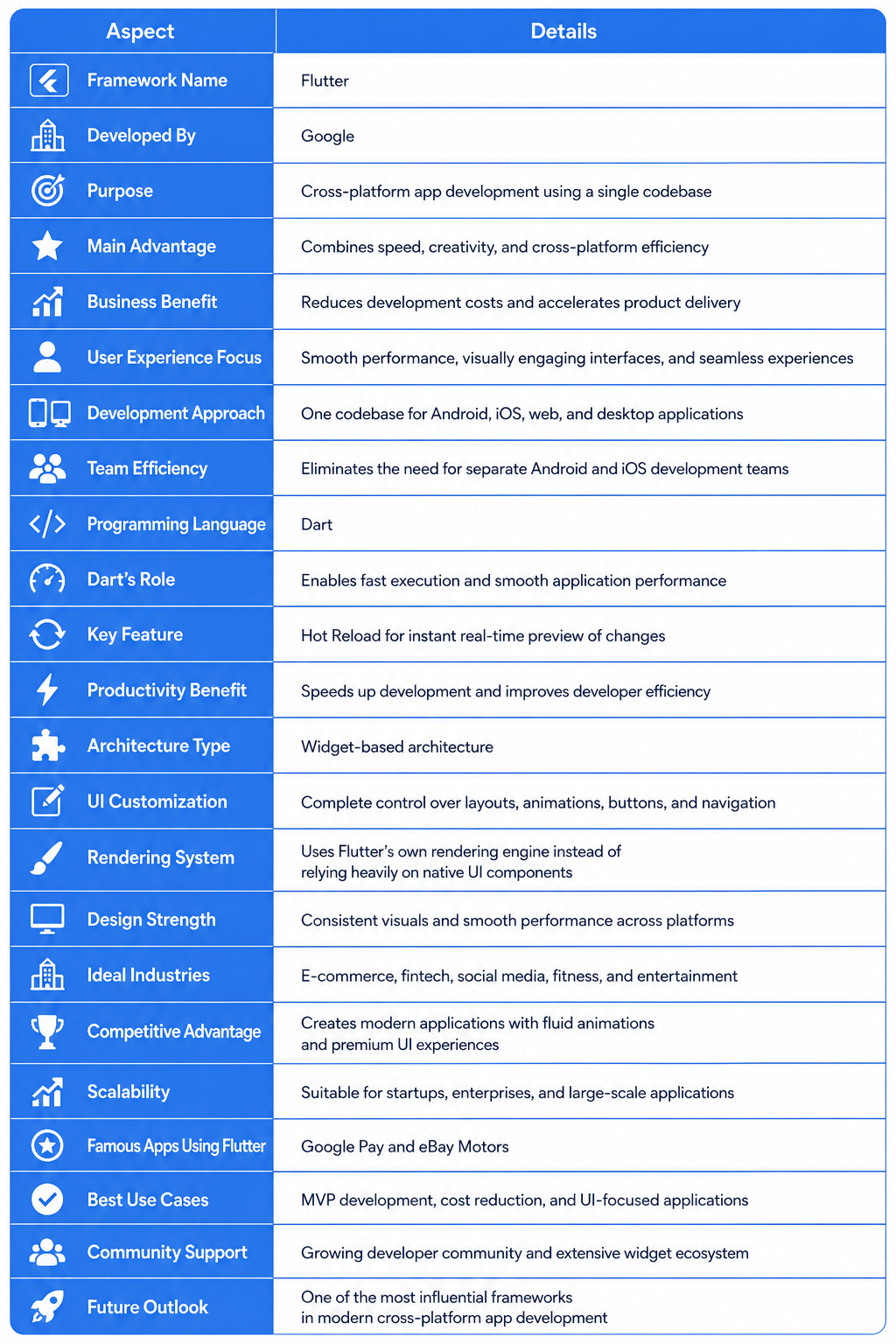
Flutter is redefining how modern businesses build mobile applications by combining speed, creativity, and cross-platform efficiency into a single powerful framework. In an era where users expect smooth performance, visually engaging interfaces, and seamless experiences across devices, businesses can no longer afford slow development cycles or inconsistent app designs. Developed by Google, Flutter was introduced as a solution that allows developers to create high-performance applications for multiple platforms using just one codebase, helping companies reduce costs while accelerating product delivery.
What makes Flutter particularly attractive is its ability to create applications that feel modern, responsive, and visually polished without requiring separate Android and iOS development teams. Instead of managing multiple codebases, businesses can streamline development operations while maintaining consistency in design and functionality. This has made Flutter one of the fastest-growing frameworks among startups, enterprises, and technology-driven brands looking to launch products quickly without compromising quality.
At the center of Flutter’s ecosystem is Dart, a programming language developed by Google to deliver fast execution and smooth application performance. Dart’s clean syntax and developer-friendly structure make it easier to build scalable applications efficiently. One of its most valuable features is Hot Reload, which allows developers to instantly preview changes in real time. This dramatically speeds up the development process, improves productivity, and enables teams to experiment with UI designs more effectively.
Flutter’s biggest competitive advantage lies in its widget-based architecture, where every part of the interface is treated as a customizable widget. From navigation bars and animations to buttons and layouts, developers gain complete control over the appearance and behavior of the application. Unlike many traditional frameworks that depend heavily on native UI components, Flutter uses its own advanced rendering engine to deliver consistent visuals and smooth performance across Android, iOS, web, and desktop platforms.
This highly UI-focused approach makes Flutter an ideal choice for businesses that want applications to stand out in competitive markets. Industries such as e-commerce, fintech, social media, fitness, and entertainment often require attractive designs and engaging user experiences to retain customers. Flutter enables brands to create modern applications with fluid animations and premium visual experiences that strengthen user engagement and brand identity.
A practical example of Flutter’s startup-focused capabilities can be seen in HobbySwap, a personal project developed by AitchSoft to explore how Flutter can accelerate modern product development with a highly interactive and visually engaging user experience. The project was designed as a cross-platform application that emphasized responsive UI design, smooth navigation, and scalable architecture while maintaining a single shared codebase across platforms.
Using Flutter’s widget-based system and Hot Reload capabilities, the development process became faster and more efficient, allowing rapid UI experimentation and feature iteration. The project highlighted how startups and product-focused teams can use Flutter to quickly transform ideas into polished applications without maintaining separate Android and iOS development environments. It also demonstrated Flutter’s strength in creating modern interfaces with fluid animations and consistent user experiences across devices.
Several globally recognized platforms have already embraced Flutter to improve scalability and accelerate development. Applications like Google Pay and eBay Motors demonstrate how Flutter can support large-scale applications while maintaining responsive performance and visually dynamic interfaces.
For startups seeking rapid MVP development, businesses aiming to reduce development costs, or companies focused on delivering exceptional UI experiences, Flutter has become a strategic technology choice. Its growing community, extensive widget ecosystem, and strong backing from Google continue to position it as one of the most influential frameworks shaping the future of cross-platform app development.
Architecture Comparison Between .NET MAUI and Flutter
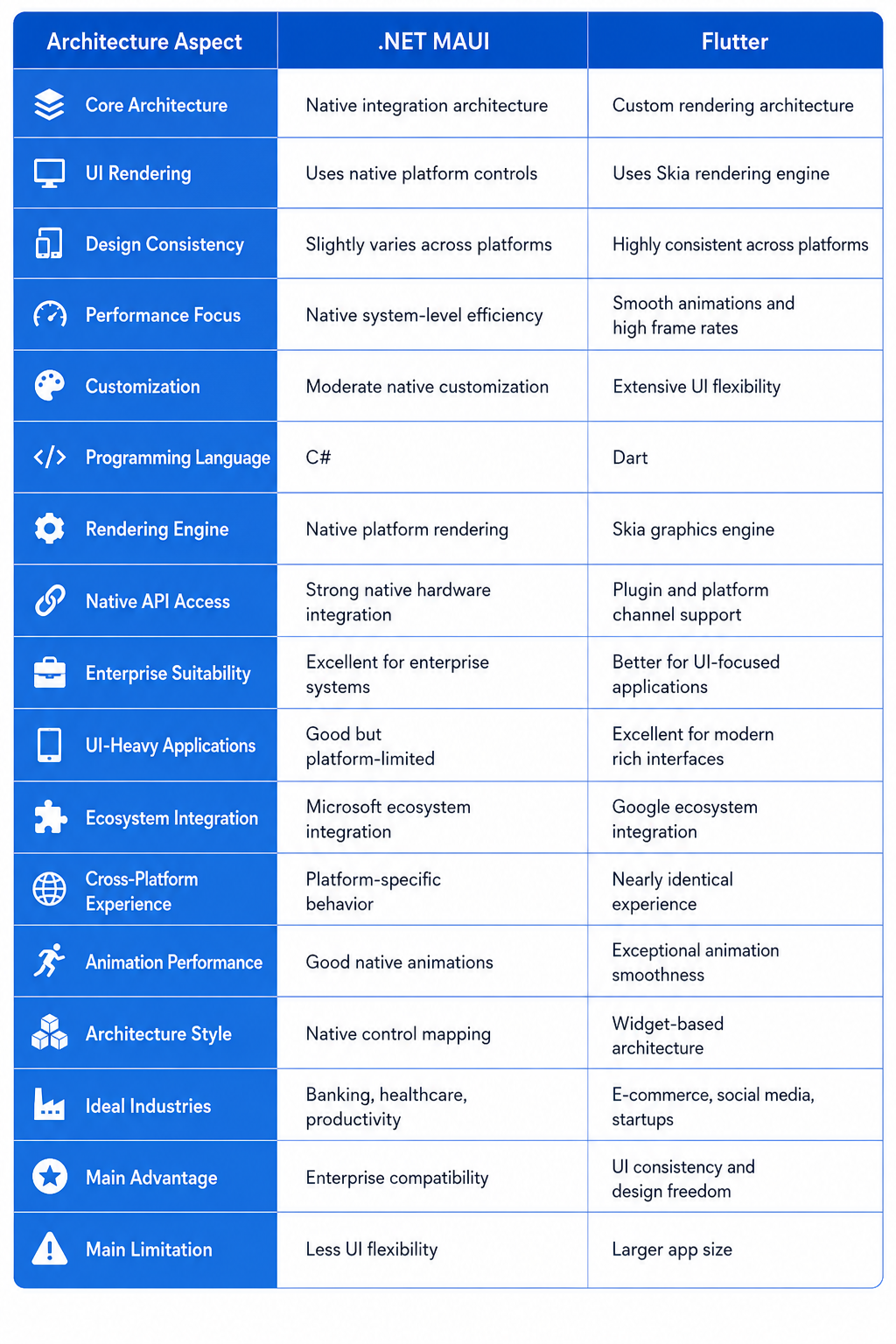
The architecture of a cross-platform framework plays a critical role in determining an application’s performance, scalability, flexibility, and long-term development efficiency. While both .NET MAUI and Flutter are designed to simplify multi-platform app development, they follow fundamentally different architectural approaches that directly influence how applications are built, rendered, and optimized. Understanding these architectural differences is essential for businesses and developers seeking the right balance between native performance, UI consistency, scalability, and customization.
One of the biggest distinctions between the two frameworks lies in how they interact with native platforms. .NET MAUIfollows a native integration approach, meaning it relies heavily on platform-native controls and APIs to render the user interface. Instead of recreating UI components from scratch, .NET MAUI maps its controls directly to native Android, iOS, Windows, and macOS components. This enables applications to feel naturally integrated within each operating system while benefiting from platform-specific optimizations and behaviors.
In contrast, Flutter uses its own high-performance rendering engine called Skia to draw every UI component directly onto the screen. Rather than depending on native UI elements, Flutter creates a fully customized interface through its widget system. This approach allows Flutter applications to maintain nearly identical designs and experiences across platforms, making it highly effective for businesses that prioritize branding consistency and visually dynamic interfaces.
The way both frameworks handle UI development also reflects their core philosophies. .NET MAUI focuses on native responsiveness and enterprise-level integration, which makes it highly suitable for applications requiring close interaction with device hardware, operating system services, or Microsoft enterprise technologies. Developers familiar with C# and the .NET ecosystem can efficiently build applications while leveraging native capabilities without sacrificing productivity.
Flutter, on the other hand, emphasizes design freedom and UI creativity. Its widget-based architecture provides developers with extensive customization capabilities, allowing them to build highly interactive interfaces with smooth animations and modern transitions. Because Flutter controls the rendering layer itself, developers can achieve visually consistent applications regardless of platform differences. This makes Flutter especially attractive for startups, e-commerce platforms, social media apps, and entertainment applications where user experience significantly impacts engagement and retention.
From a performance perspective, both frameworks deliver strong results but through different structures. .NET MAUI benefits from native platform rendering and optimized access to system resources, which can improve integration efficiency for enterprise and productivity applications. Flutter’s rendering engine, however, is designed for high frame-rate performance and smooth animations, often delivering exceptional responsiveness in graphics-intensive or UI-heavy applications.
Flexibility and scalability are also influenced by architectural design. .NET MAUI offers excellent scalability for organizations already invested in the Microsoft ecosystem, particularly businesses using technologies such as Azure, ASP.NET, or enterprise cloud services. Its architecture supports long-term maintainability and enterprise-grade application development.
Flutter excels in flexibility by allowing developers to create highly customized interfaces without platform limitations. Its consistent rendering engine and rapidly growing ecosystem make it easier to scale applications across mobile, desktop, and web platforms while maintaining design uniformity. This flexibility gives businesses greater creative control when building customer-focused digital products.
Ultimately, the architectural comparison between .NET MAUI and Flutter reflects two different development priorities. .NET MAUI focuses on native integration, enterprise compatibility, and Microsoft ecosystem efficiency, while Flutter prioritizes UI consistency, rendering performance, and design flexibility. The better choice depends largely on whether a business values deep native integration or complete control over the visual user experience.
Performance Analysis of .NET MAUI and Flutter
Performance is one of the most decisive factors when choosing a cross-platform framework because users expect applications to be fast, responsive, and visually smooth across every device. Even a slight delay in loading time, animation responsiveness, or UI rendering can negatively impact user experience and customer retention. While both .NET MAUI and Flutter are designed to deliver high-performance applications, they achieve this performance through different technical approaches, resulting in distinct strengths and limitations.
App Speed
Application speed directly affects how users interact with mobile apps in real-world environments. .NET MAUI delivers strong performance by utilizing native platform APIs and controls, allowing applications to integrate efficiently with Android, iOS, Windows, and macOS operating systems. Because .NET MAUI applications interact closely with native components, enterprise and business applications often perform reliably when handling data processing, authentication systems, and backend integrations.
Flutter, however, is widely recognized for its exceptionally fast UI responsiveness. Flutter compiles directly into native ARM machine code, reducing performance overhead and enabling rapid execution. This often gives Flutter an advantage in applications requiring highly interactive interfaces, real-time updates, or visually dynamic experiences.
Rendering Performance
One of the biggest architectural differences between the two frameworks appears in rendering performance. .NET MAUI depends on native rendering, meaning the framework translates UI components into platform-native controls. This ensures applications feel natural within each operating system and provides stable rendering performance for productivity and enterprise-focused apps.
Flutter follows a completely different rendering strategy by using the Skia graphics engine to draw every pixel directly onto the screen. Instead of relying on native UI components, Flutter controls the entire rendering pipeline itself. This allows Flutter to maintain highly consistent UI performance across devices while delivering fluid transitions and visually polished interfaces. As a result, Flutter is often considered stronger for graphics-intensive applications and custom UI experiences.
Memory Management
Efficient memory management is critical for maintaining stable application performance, especially in large-scale applications. .NET MAUI benefits from the mature .NET runtime and garbage collection system, which helps optimize memory allocation and application stability. This becomes particularly useful for enterprise systems handling large datasets, cloud synchronization, and long-running business processes.
Flutter also provides efficient memory handling through the Dart runtime, but because it renders everything independently, complex interfaces with excessive widget trees may increase memory consumption if not properly optimized. Despite this, Flutter remains highly competitive in overall memory efficiency, especially for medium-sized and UI-driven applications.
Animation Smoothness
Animation smoothness has become a major competitive factor in modern app development because users increasingly associate smooth interactions with premium quality applications. Flutter has gained a strong reputation in this area due to its high frame-rate rendering capabilities and direct graphics control. The framework consistently delivers smooth animations, transitions, and scrolling experiences, even in highly customized interfaces.
While .NET MAUI also supports animations and responsive UI interactions, its reliance on native rendering can sometimes create slight inconsistencies across platforms depending on device optimization. For standard business applications, this difference may be minimal, but for highly animated consumer applications, Flutter generally offers a more visually fluid experience.
Startup Time Comparison
Application startup time significantly influences first impressions and user retention. .NET MAUI applications can sometimes experience slightly longer startup times due to the initialization of the .NET runtime and platform dependencies. However, Microsoft continues improving startup optimization with each framework update.
Flutter applications typically achieve faster startup performance because of ahead-of-time compilation and lightweight rendering initialization. This allows many Flutter apps to launch quickly while maintaining smooth transitions immediately after startup.
Overall Performance Perspective
Both frameworks provide strong cross-platform performance, but they excel in different environments. .NET MAUI is highly effective for enterprise systems, productivity applications, and businesses deeply integrated with the Microsoft ecosystem. Flutter, on the other hand, stands out for UI-intensive applications, animation-heavy experiences, and visually engaging consumer products.
Ultimately, the performance comparison between .NET MAUI and Flutter depends less on which framework is universally faster and more on which framework aligns better with the technical and business goals of a specific application.
UI/UX Experience in .NET MAUI and Flutter
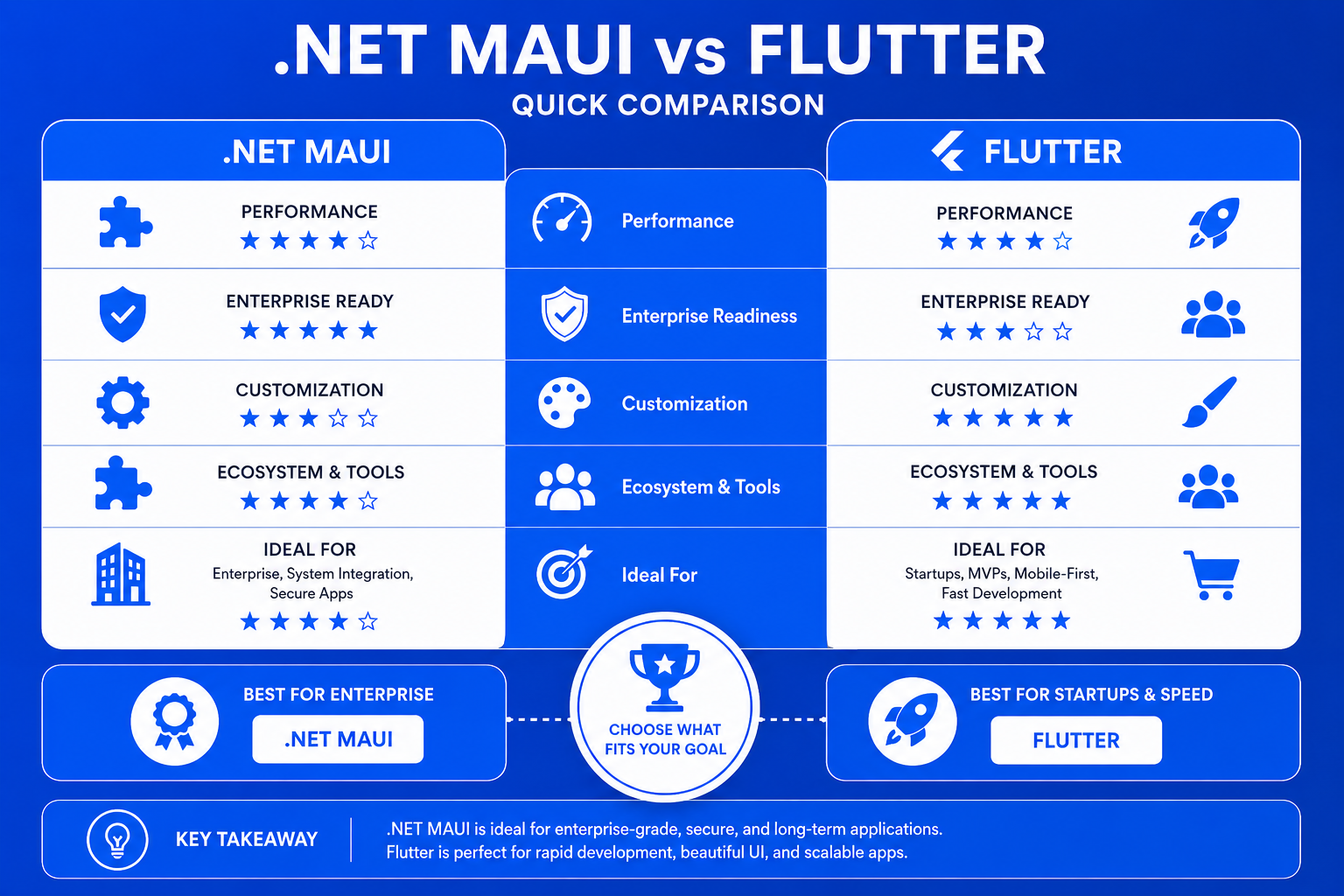
User interface and user experience have become defining factors in the success of modern mobile applications because users now expect applications to be visually appealing, responsive, and easy to navigate. Both .NET MAUI and Flutter provide strong UI/UX capabilities, but they approach design flexibility, animations, and user interaction from very different perspectives. While .NET MAUI focuses on delivering a more native look and feel through platform-integrated components, Flutter emphasizes creative freedom and visually consistent interfaces across all devices.
.NET MAUI is designed around native UI integration, allowing applications to automatically adopt the appearance and behavior of Android, iOS, Windows, and macOS systems. This creates a familiar experience for users because the application feels naturally aligned with the operating system they are using. Businesses developing enterprise applications, productivity tools, or service-based platforms often prefer .NET MAUI because it provides reliable navigation patterns, responsive layouts, and smooth integration with device-native capabilities. Its deep connection with the Microsoft ecosystem also allows developers to create structured and professional business interfaces efficiently.
On the other hand, Flutter is widely recognized for its exceptional design flexibility and modern UI capabilities. Flutter’s widget-based architecture gives developers complete control over every visual element of the application, enabling the creation of highly customized interfaces, advanced transitions, and fluid animations. Because Flutter uses its own rendering engine rather than relying entirely on native controls, developers can achieve visually identical designs across multiple platforms without inconsistencies. This makes Flutter especially powerful for brands that prioritize strong visual identity and engaging customer experiences.
Custom animations are another area where Flutter often gains a competitive advantage. The framework is optimized for smooth motion rendering and high frame-rate performance, allowing developers to build interactive user experiences with responsive transitions and visually polished effects. Applications in industries such as e-commerce, entertainment, social media, and fitness frequently benefit from Flutter’s ability to deliver premium animation quality and modern interface interactions.
In terms of overall user experience, .NET MAUI delivers stability, native responsiveness, and platform familiarity, making it highly suitable for enterprise-focused environments where functionality and system integration are priorities. Flutter, however, excels in delivering visually immersive experiences with modern design consistency and dynamic interactions, making it ideal for customer-centric applications focused on engagement and branding.
Community and Ecosystem of .NET MAUI and Flutter
A strong community and ecosystem play a major role in the long-term success of any cross-platform framework because developers rely heavily on documentation, plugins, updates, and community-driven solutions to accelerate development. Both .NET MAUI and Flutter are open-source frameworks backed by major technology companies, but their ecosystem strength differs in scale and maturity.
Flutter currently holds a larger and more active global developer community, supported by an extensive package ecosystem, frequent updates, and strong open-source contributions. Its rich collection of plugins and UI libraries allows developers to quickly build modern applications with fewer development limitations. Flutter also benefits from highly detailed documentation and a rapidly expanding community that continuously contributes tutorials, tools, and third-party integrations.
In comparison, .NET MAUI offers strong enterprise-level support through the Microsoft ecosystem and integrates efficiently with existing .NET technologies. Although its community is smaller than Flutter’s, .NET MAUI benefits from the long-standing reliability of C# and Microsoft development platforms. It is steadily growing, particularly among enterprise developers and organizations already invested in Microsoft technologies.
Overall, Flutter currently leads in community size, plugin availability, and ecosystem expansion, while .NET MAUI remains a strong choice for businesses seeking long-term enterprise support and deep integration within the Microsoft development environment.
Enterprise vs Startup Perspective
The difference between .NET MAUI and Flutter becomes more visible when analyzing how enterprises and startups use these frameworks to solve different business challenges. Large enterprises typically prioritize security, scalability, long-term maintenance, and system integration, while startups focus more on rapid deployment, lower development costs, and faster market validation.
For enterprises, .NET MAUI offers a strategic advantage because of its seamless integration with Microsoft technologies such as Azure, Active Directory, SQL Server, and ASP.NET. Many enterprises already operate within Microsoft environments, making it easier to expand existing systems into mobile and desktop applications without rebuilding infrastructure from scratch. A strong example can be seen in healthcare and banking sectors, where companies require secure authentication systems, cloud synchronization, and enterprise-level data management. Organizations using Microsoft enterprise services can reduce operational complexity by leveraging existing C# development teams instead of hiring separate Android and iOS specialists. According to enterprise development trends, businesses adopting unified Microsoft ecosystems often reduce long-term maintenance costs and improve development consistency across platforms.
Flutter, however, dominates startup culture because of its speed and flexibility. Startups often work with limited budgets and smaller teams, requiring technologies that support rapid MVP development. A well-known case study is Google Pay, which adopted Flutter to improve development efficiency and deliver a consistent user experience across platforms. Similarly, many e-commerce and fintech startups choose Flutter because it enables highly customized interfaces and faster product iteration. Industry reports consistently show that startups using cross-platform frameworks reduce initial development costs significantly compared to maintaining separate native teams. Flutter’s ability to launch applications quickly while maintaining visually attractive UI makes it particularly valuable in highly competitive consumer markets.
Desktop and Web Support
The evolution of cross-platform development has expanded far beyond smartphones, as businesses increasingly require applications that function consistently across mobile, desktop, and web environments. .NET MAUI has positioned itself strongly in desktop-focused development, particularly for Windows-based enterprise systems. Because Microsoft designed MAUI as part of the broader .NET ecosystem, businesses can efficiently create applications that operate across Windows desktops, mobile devices, and macOS while maintaining shared architecture. This becomes especially valuable for internal management systems, inventory software, and enterprise dashboards where desktop productivity remains essential.
A practical example can be observed in logistics and manufacturing companies that rely heavily on Windows-based operational systems. By using .NET MAUI, organizations can extend existing desktop software into mobile solutions without rebuilding entire infrastructures. This reduces software fragmentation and improves operational efficiency.
Meanwhile, Flutter has rapidly expanded its capabilities beyond mobile development into desktop and web platforms. Flutter’s rendering engine enables visually consistent interfaces across Windows, macOS, Linux, and web browsers. A notable case study is eBay Motors, which used Flutter to improve UI consistency and user experience across platforms. Flutter’s web capabilities are especially attractive for startups and digital brands seeking unified branding experiences across all customer touchpoints.
Industry trends in 2026 show that businesses increasingly prefer frameworks capable of supporting multiple platforms simultaneously, reducing operational silos and accelerating digital transformation strategies.
Cost and Development Efficiency
One of the strongest arguments supporting cross-platform development is the ability to reduce operational expenses while accelerating product delivery. Both .NET MAUI and Flutter provide significant cost-saving opportunities by allowing developers to maintain a single codebase instead of separate Android and iOS projects. This directly lowers development, testing, and maintenance costs.
Flutter has become particularly popular among startups because of its ability to reduce time-to-market. For example, many early-stage fintech and delivery startups have used Flutter to launch MVPs within months rather than building separate native applications. Faster deployment enables startups to validate business ideas earlier and attract investor interest more efficiently. Industry estimates suggest that cross-platform frameworks can reduce development effort by up to 30–40% compared to traditional native development in certain project types.
.NET MAUI, however, creates development efficiency from an enterprise perspective. Businesses already using C#, ASP.NET, and Azure can extend existing development teams into mobile and desktop projects without retraining developers in entirely new programming languages. This significantly reduces recruitment costs and improves long-term maintainability.
A practical enterprise case study can be seen in internal workforce management systems where organizations unify desktop and mobile operations under one development structure. Instead of maintaining isolated software teams, businesses can centralize development workflows and streamline software updates across departments.
Market Trends in 2026
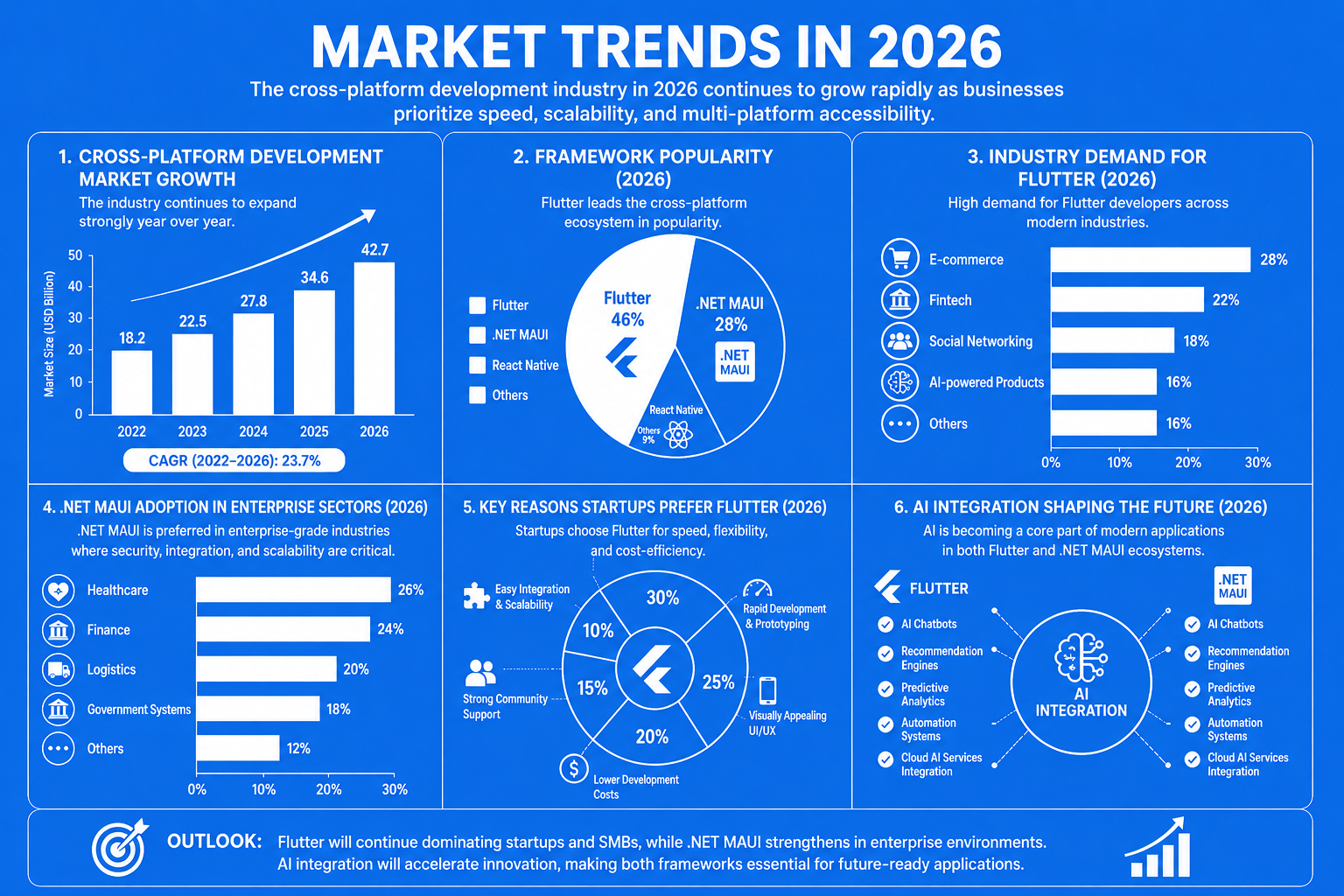
The cross-platform development industry in 2026 continues to grow rapidly as businesses prioritize speed, scalability, and multi-platform accessibility. Flutter currently leads much of the freelance and startup ecosystem because of its strong community support and modern UI capabilities. Freelance platforms increasingly show higher demand for Flutter developers in industries such as e-commerce, fintech, social networking, and AI-powered mobile products.
According to developer ecosystem trends, Flutter consistently ranks among the most popular cross-platform frameworks because of its active community and rapid innovation cycle. Startups favor Flutter because it enables rapid experimentation, visually appealing products, and lower development costs.
Industry reports in 2025–2026 suggest that approximately 46% of mobile developers actively use Flutter for cross-platform app development. Flutter’s open-source ecosystem has also surpassed 170,000 GitHub stars, highlighting the framework’s growing commercial and developer adoption (Stack Overflow Developer Survey 2025; GitHub Flutter Repository).
In contrast, .NET MAUI continues gaining momentum within enterprise sectors where security, system integration, and scalability are critical priorities. Industries such as healthcare, finance, logistics, and government systems increasingly adopt .NET MAUI for enterprise-grade applications requiring stable infrastructure and long-term support.
Microsoft positions .NET MAUI as a modern enterprise-focused framework designed for scalable cross-platform development with strong native integration and cloud compatibility (Microsoft .NET MAUI Documentation, 2025).
Artificial intelligence integration is also shaping the future of both frameworks. Businesses are increasingly embedding AI chatbots, recommendation engines, predictive analytics, and automation systems into applications. Both Flutter and .NET MAUI now support integration with cloud AI services, making them increasingly relevant in AI-driven software development strategies.
Pros and Cons
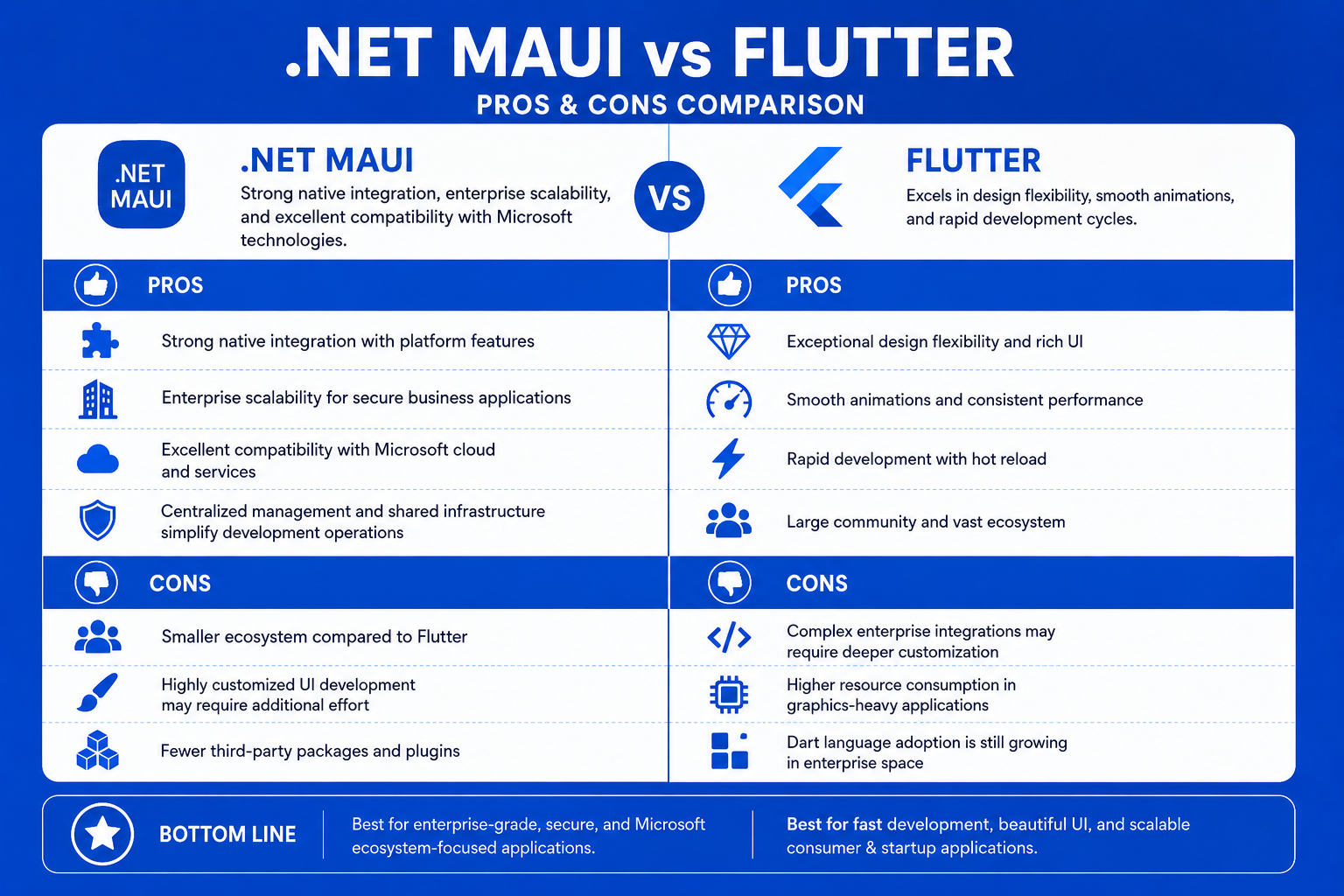
.NET MAUI offers strong native integration, enterprise scalability, and excellent compatibility with Microsoft technologies. Its biggest strength lies in supporting secure business applications and enterprise systems.
For example, companies already operating within Microsoft cloud environments can significantly simplify development operations through shared infrastructure and centralized management. However, its ecosystem is still smaller than Flutter’s, and highly customized UI development may require additional effort.
Work
A real-world example is “OneTrak,” a production fleet management application built with .NET MAUI. The application uses .NET 10, Prism DryIoc for dependency injection, Refit for typed API consumption, and Shiny for background device monitoring. It also integrates real-time GPS tracking and Google Maps, telemetry visualisation with Microcharts and SkiaSharp, and data-dense interfaces using Syncfusion and CommunityToolkit.
Explore the “OneTrak” case study to see how .NET MAUI can be used to build a feature-rich, production-ready fleet management application. However, its ecosystem is still smaller than Flutter’s, and highly customized UI development may require additional effort.
Flutter excels in design flexibility, smooth animations, and rapid development cycles. A major advantage is its ability to create visually rich applications with consistent UI across platforms. Case studies such as Google Pay demonstrate Flutter’s scalability in real-world production environments. However, some highly complex enterprise integrations may require deeper customization, and resource consumption can increase in graphics-heavy applications if optimization is not handled properly.
Which Framework Should You Choose?
The decision between .NET MAUI and Flutter should be based on business goals, technical infrastructure, and target audience requirements rather than popularity alone. Businesses already invested in Microsoft technologies, enterprise cloud systems, and internal business operations often gain greater long-term value from .NET MAUI because of its scalability and ecosystem compatibility.
For example, a healthcare organization managing secure patient systems and internal dashboards would likely benefit more from .NET MAUI’s enterprise-focused architecture. In contrast, a startup launching a modern e-commerce platform or social networking application may prioritize Flutter because of its faster development speed and highly engaging UI capabilities.
Developer expertise also influences the decision. Teams experienced in C# and enterprise software development may transition naturally into .NET MAUI, while teams focused on creative UI development and rapid product experimentation often prefer Flutter and Dart.
Final Thoughts
The growing competition between .NET MAUI and Flutter reflects the broader transformation occurring in modern software development. Businesses are no longer selecting frameworks solely based on technical specifications; they are choosing technologies that align with operational goals, customer expectations, scalability needs, and long-term digital strategies.
Real-world adoption patterns show that Flutter continues dominating startup-driven innovation and UI-focused applications, while .NET MAUI strengthens its position within enterprise ecosystems and Microsoft-integrated business environments. The future of cross-platform development will likely involve deeper AI integration, broader desktop-web-mobile unification, and increasingly intelligent user experiences.
Ultimately, the best framework is not the one with the loudest market presence but the one that strategically supports the specific goals, growth plans, and technological vision of the business adopting it.
FAQ's : .NET MAUI vs Flutter
1. What is the main difference between Flutter and .NET MAUI?
Flutter uses its own rendering engine to create highly consistent and customizable UI across platforms, while .NET MAUI relies more on native platform controls and integrates deeply with the Microsoft ecosystem.
2. Which framework is easier to learn in 2026?
Flutter is generally easier for beginners with modern UI-focused development, while .NET MAUI is easier for developers already experienced with C# and .NET technologies.
3. Is Flutter better for UI and animations?
Yes, Flutter is widely recognized for smooth animations, visually rich interfaces, and highly customizable UI experiences across Android, iOS, web, and desktop platforms.
4. Which framework is better for enterprise applications?
.NET MAUI is often preferred for enterprise applications because of its strong integration with Microsoft services such as Azure, ASP.NET Core, Active Directory, and SQL Server.
5. Does Flutter provide good performance for large-scale applications?
Yes, Flutter delivers strong performance for scalable applications through its fast rendering engine, optimized widgets, and efficient cross-platform architecture.
6. Which framework has better community support?
Flutter currently has a larger global community, extensive open-source packages, and broader developer adoption compared to .NET MAUI.
7. Can Flutter and .NET MAUI support AI-powered applications?
Yes, both frameworks support AI integrations such as chatbots, recommendation engines, predictive analytics, and cloud AI services through third-party APIs and cloud platforms.
8. Which framework is more cost-effective for startups?
Flutter is often considered more cost-effective because startups can build Android, iOS, web, and desktop applications using a single codebase with faster development cycles.
9. Is .NET MAUI suitable for long-term business scalability?
Yes, .NET MAUI is highly scalable for businesses that rely on Microsoft infrastructure and require secure, maintainable, and enterprise-grade solutions.
10. Which framework is expected to grow more in the future?
Both frameworks are expected to grow in 2026 and beyond. Flutter is projected to dominate startup and UI-centric markets, while .NET MAUI is expected to strengthen its position in enterprise development and business applications.