 services@aitchsoft.com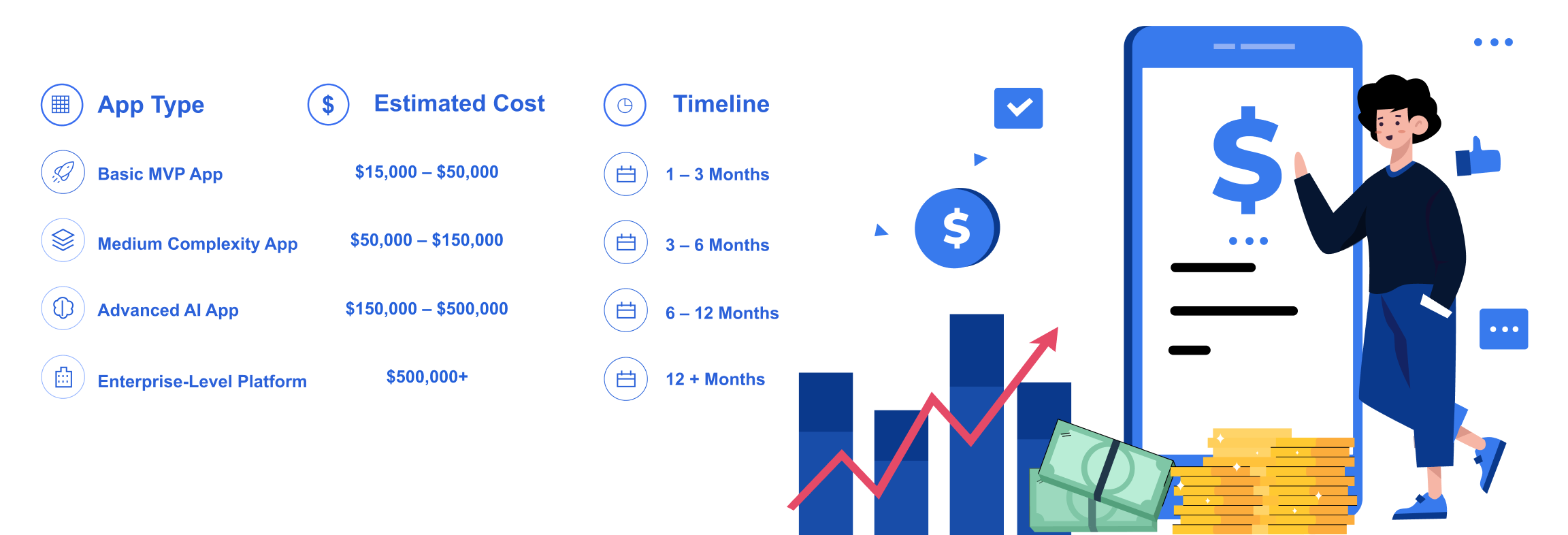
In 2026, building an app is no longer just about turning an idea into code. Today,businesses expect intelligent user experiences, AI-powered automation, lightning-fast performance, real-time synchronization, and seamless functionality across multiple devices.
Whether it’s a startup launching its first MVP or an enterprise scaling a digital product, the expectations around mobile apps have dramatically evolved.
But despite all the innovation, one question continues to dominate every discussion:
“How much does it actually cost to build an app in 2026?”
The answer is not as simple as most businesses expect.
App development no longer follows a fixed pricing model because every application is built differently.
The total cost depends on several critical factors, including app complexity, feature requirements, UI/UX design quality, platform selection, third-party integrations, security standards, and the expertise of the development team.
In addition, modern technologies are reshaping how businesses approach development budgets. AI-powered features such as chatbots, recommendation engines, automation systems, and predictive analytics are increasing both development capabilities and costs. At the same time, cross-platform frameworks like Flutter and .NET MAUI are helping companies reduce expenses by building apps for iOS and Android simultaneously.
As a result, app development costs in 2026 can range anywhere from $15,000 for a basic MVP to $500,000 or more for large-scale enterprise applications with advanced functionality, AI integration, cloud infrastructure, and high-performance architecture.
Understanding where your app falls within this range is essential before starting development. In this guide, we’ll break down the real factors that influence app development costs in 2026, helping you estimate budgets more accurately and avoid expensive mistakes during the development process.
Average App Development Cost in 2026
One of the biggest misconceptions in the tech industry is that app development has a “standard” price.
In reality, the cost depends entirely on the scope of the project, feature complexity, technology stack, and long-term scalability requirements.
A simple MVP built for market validation will cost significantly less than an AI-powered enterprise platform handling millions of users and real-time data processing.
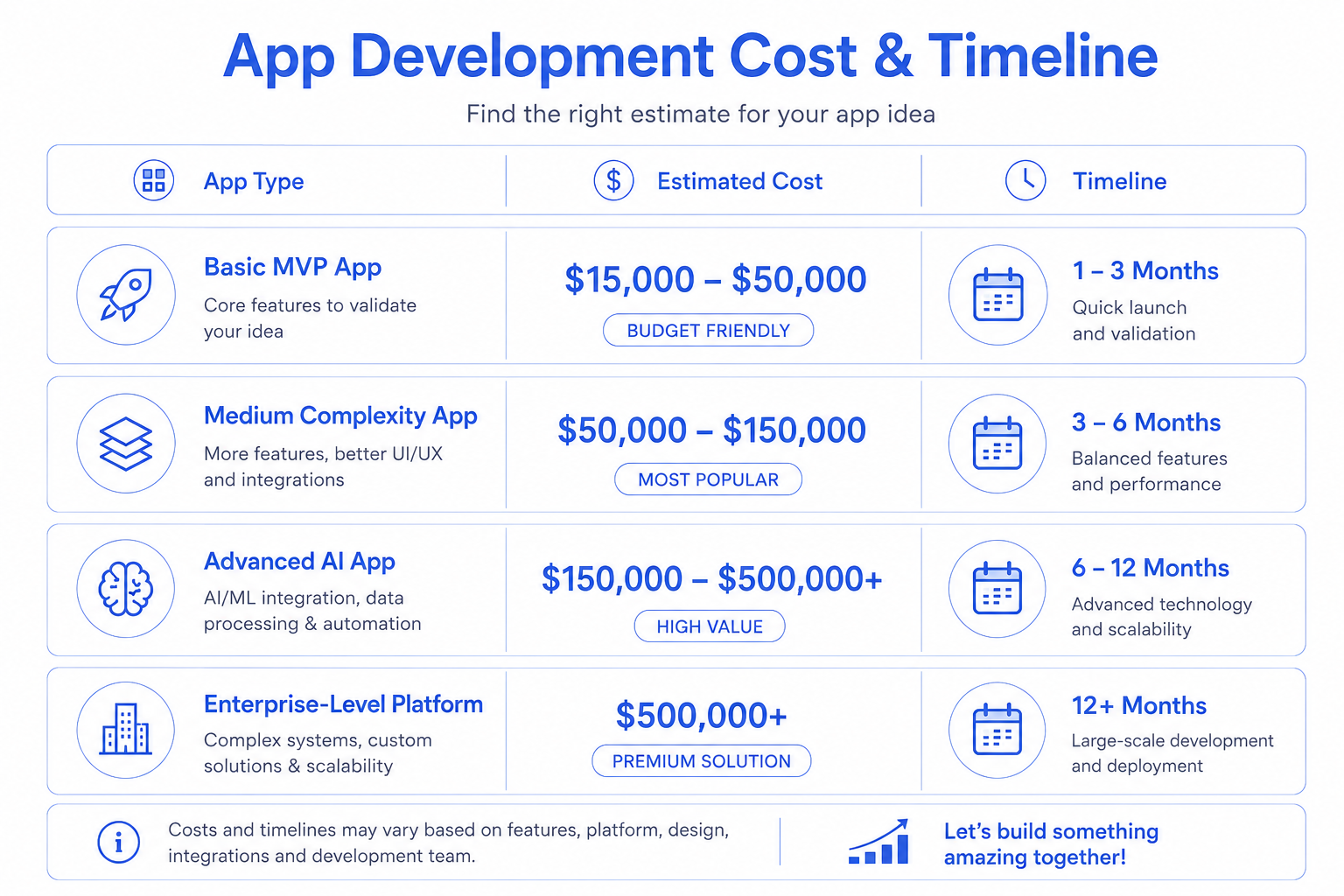
Here’s a general breakdown of app development costs in 2026:
Basic MVP Apps ($15,000 – $50,000)
A Minimum Viable Product (MVP) is the most affordable way to launch an app idea in 2026. These apps focus only on core functionality instead of advanced features. The goal is simple: validate the market quickly without investing heavily in full-scale development.
MVP apps usually include:
- Basic user authentication
- Simple UI/UX design
- Limited integrations
- Essential features only
- Cross-platform development for faster delivery
Startups prefer MVPs because they reduce risk, shorten launch timelines, and allow businesses to gather real user feedback before scaling further.
Medium Complexity Apps ($50,000 – $150,000)
As businesses grow, apps require more advanced functionality and polished user experiences. Medium-complexity apps often include features such as:
- Payment gateways
- Real-time chat
- Push notifications
- Analytics dashboards
- API integrations
- Subscription systems
- Cloud synchronization
These applications also require stronger backend architecture, better performance optimization, and enhanced UI/UX design, which naturally increases development costs and timelines.
Advanced AI Apps ($150,000 – $500,000+)
AI is one of the biggest cost drivers in app development in 2026. Applications powered by artificial intelligence require significantly larger budgets because they involve advanced engineering, data processing, machine learning models, and infrastructure scaling.
AI-powered apps may include:
- AI chatbots
- Recommendation engines
- Predictive analytics
- Voice assistants
- Image recognition
- Personalized automation
- Smart search systems
Beyond development, AI apps also involve ongoing training, cloud computing costs, model optimization, and continuous performance monitoring. This makes them substantially more expensive than traditional mobile applications.
Enterprise-Level Platforms ($500,000+)
Enterprise applications operate on a completely different scale. These platforms are designed for large organizations that require high-level security, scalability, reliability, and integration with multiple internal systems.
Enterprise-grade apps often include:
- Advanced security protocols
- Multi-user role management
- Large-scale databases
- ERP/CRM integrations
- Real-time reporting systems
- High-performance cloud infrastructure
- Compliance requirements
- Scalable architecture for millions of users
In 2026, enterprise platforms are no longer just apps — they are complete digital ecosystems. Development involves large teams of developers, UI/UX designers, DevOps engineers, QA specialists, security experts, and cloud architects working together over long timelines.
That’s why enterprise app development costs can easily exceed several hundred thousand dollars, especially when AI, automation, and multi-platform support are involved.
Key Factors That Affect App Development Cost in 2026
When businesses ask, “Why does one app cost $20,000 while another costs $500,000+?” the answer almost always comes down to the features, technology, and scalability behind the product.
In 2026, app development is no longer just about creating screens and writing code. Modern applications are expected to deliver intelligent experiences, real-time performance, advanced personalization, and seamless functionality across multiple devices and platforms.
The more sophisticated the app becomes, the higher the development cost.
Here are the biggest factors that directly influence app development pricing in 2026.
a) App Complexity
App complexity is the single biggest factor affecting development cost. The more functionality your application requires, the more time, developers, testing, and infrastructure are needed to build it successfully.
A simple app with limited features is relatively affordable. However, once advanced systems and real-time functionality are introduced, costs increase rapidly.
Basic app features may include:
- User registration and login systems
- User profiles
- Push notifications
- Basic dashboards
- Content management
But modern apps in 2026 often demand far more advanced functionality, such as:
- Real-time chat systems
- Payment gateway integrations
- AI-powered recommendations
- Multi-user admin panels
- Live data synchronization
- Subscription systems
- Video streaming
- Automation workflows
For example, adding a secure payment system alone requires compliance, encryption, backend validation, and transaction monitoring.
Similarly, real-time chat functionality demands socket architecture, cloud synchronization, and database optimization.
AI-powered features increase complexity even further because they involve machine learning models, data processing, and intelligent automation.
Simply put, the more advanced the functionality, the higher the app development cost.
b) Platform Choice
One of the earliest decisions businesses must make is choosing which platform to develop for.
This directly impacts both development time and overall budget.
Companies typically choose between:
- iOS app development
- Android app development
- Cross-platform app development
Building separate native apps for iOS and Android often delivers maximum performance and platform-specific optimization, but it also requires two separate codebases and larger development teams. This naturally increases costs.
That’s why many startups and businesses in 2026 are shifting toward cross-platform app development to reduce expenses and accelerate launch timelines.
Modern frameworks like Flutter app development and React Native app cost optimization are changing how companies approach mobile app development. Instead of building two completely separate applications, developers can now use a single shared codebase for both iOS and Android platforms.
This approach offers several major advantages:
- Faster development cycles
- Reduced maintenance costs
- Lower development budgets
- Simultaneous multi-platform deployment
- Easier updates and feature releases
For startups especially, cross-platform development has become one of the most cost-effective strategies for entering the market quickly without sacrificing app quality.
However, highly complex enterprise apps or graphics-intensive applications may still require native development for maximum performance and scalability.
c) UI/UX Design
In 2026, users judge an app within seconds.
No matter how powerful the backend is, poor design can instantly destroy user trust and engagement. That’s why UI/UX design has become a major investment area in modern app development.
Today’s users expect:
- Smooth navigation
- Personalized experiences
- Fast interactions
- Modern layouts
- Beautiful animations
- Accessibility support
- Consistent performance across devices
A polished user experience is no longer optional — it’s a competitive advantage.
Basic app interfaces are cheaper to design, but premium applications often require:
- Custom animations
- Interactive transitions
- Advanced prototyping
- UX research
- User behavior testing
- Accessibility optimization
- Personalized user flows
For example, apps like fintech platforms, healthcare solutions, or AI-powered products require extremely intuitive user experiences because users expect simplicity despite complex functionality happening in the background.
The more customized and premium the design experience becomes, the higher the development and design costs increase.
d) AI Features
Artificial Intelligence is one of the biggest trends shaping app development in 2026 — and one of the largest contributors to rising development costs.
Businesses are increasingly integrating AI to create smarter, faster, and more personalized applications.
Modern AI-powered apps now include:
- AI chatbots
- Recommendation engines
- AI summarization tools
- Voice assistants
- Smart automation systems
- Predictive analytics
- Personalized content delivery
These features dramatically improve user engagement and operational efficiency, but they also require specialized development expertise and infrastructure.
Unlike traditional app features, AI systems require:
- AI APIs and integrations
- Machine learning models
- Cloud computing resources
- Data processing pipelines
- Model training and optimization
- AI engineering expertise
For example, building an AI chatbot is not just about creating a messaging interface. Developers must integrate natural language processing systems, train models, optimize response accuracy, and maintain scalable infrastructure capable of handling real-time interactions.
As AI adoption continues to grow, businesses should expect higher upfront investments when building intelligent applications.However, for many companies, the long-term automation benefits and improved user engagement justify the increased development costs.
e) Backend Infrastructure
The frontend design is what users see, but the backend infrastructure is what keeps the entire application running smoothly behind the scenes.
In many modern applications, backend development represents a significant portion of the total budget.
Backend infrastructure includes:
- Servers
- Databases
- APIs
- Cloud hosting
- Authentication systems
- Real-time synchronization
- Security architecture
- Scalability management
As apps grow, backend systems must handle increasing numbers of users, transactions, files, and real-time requests without performance issues.
For example:
- Social media apps process massive amounts of real-time content
- E-commerce apps manage transactions and inventory
- AI apps require high-performance computing power
- Enterprise systems handle large-scale business operations
Modern businesses also rely heavily on cloud infrastructure platforms such as:
- AWS
- Firebase
- Azure
These platforms provide scalability, storage, security, and server management — but they also introduce recurring operational costs.
In AI-powered applications, infrastructure expenses become even higher due to GPU processing, AI model hosting, and large-scale data processing requirements.
This means app development costs are no longer limited to initial development. Businesses must also plan for long-term maintenance, cloud hosting, security updates, and infrastructure scaling as their applications grow.
One of the most effective ways to estimate your app budget in 2026 is by understanding how pricing varies across different app categories.
Not all applications are built the same. An e-commerce app has completely different requirements compared to a healthcare platform or an AI-powered SaaS product. Some apps focus heavily on user engagement, while others require advanced security, real-time infrastructure, or intelligent automation.
That’s why development costs can vary dramatically depending on the app category, feature complexity, and scalability requirements.
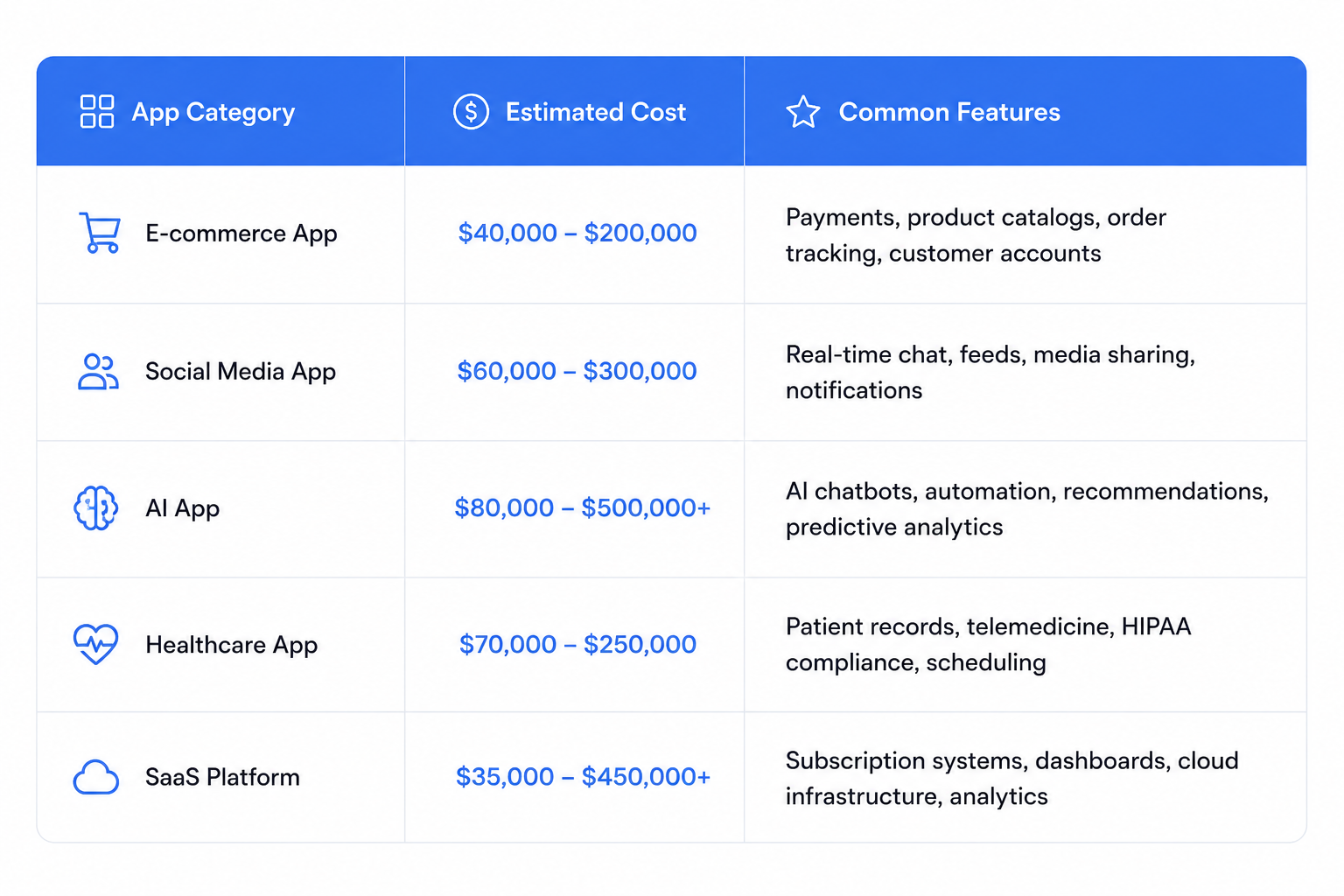
Here’s a breakdown of the average app development cost by category in 2026:
f) E-commerce App Development Cost ($40,000 – $200,000)
E-commerce applications remain one of the fastest-growing app categories in 2026 as businesses continue shifting toward digital commerce and mobile shopping experiences.
Modern e-commerce apps are no longer just online stores. Users now expect:
- Personalized recommendations
- One-click checkout
- Real-time order tracking
- AI-powered product suggestions
- Multiple payment gateways
- Inventory synchronization
- Customer support automation
The cost of developing an e-commerce app depends heavily on the number of products, integrations, user traffic, and backend complexity.
For example, a small Shopify-style shopping app may cost significantly less than a multi-vendor marketplace with advanced analytics, AI recommendations, and warehouse integrations.
Businesses investing in premium shopping experiences often spend more on UI/UX design because user experience directly impacts conversion rates and customer retention.
Social Media App Development Cost ($60,000 – $300,000)
Social media applications are among the most technically demanding apps to build because they rely heavily on real-time interactions and high user engagement.
Modern social platforms require:
- Real-time messaging
- Content feeds
- Video and image uploads
- Notifications
- Live streaming
- User engagement systems
- AI-based content recommendations
Apps like Instagram, TikTok, and LinkedIn have raised user expectations dramatically. In 2026, users expect fast performance, intelligent feeds, smooth scrolling, and highly personalized experiences.
The complexity increases even further when integrating:
- AI moderation systems
- Recommendation algorithms
- Advanced privacy settings
- Scalable cloud infrastructure
Since social media apps process massive amounts of real-time data, infrastructure and scalability become major cost factors during development.
AI App Development Cost ($80,000 – $500,000+)
AI-powered applications are one of the biggest technology trends in 2026, but they are also among the most expensive applications to build.
Unlike traditional apps, AI applications require advanced engineering, cloud computing, data processing, and machine learning integration.
AI app features may include:
- AI chatbots
- Smart automation
- Recommendation systems
- AI summarization
- Voice assistants
- Predictive analytics
- Image and speech recognition
The development cost rises because businesses must invest in:
- AI APIs
- Machine learning infrastructure
- Cloud GPU processing
- Model training
- Data engineering
- AI optimization and testing
For example, building a simple AI chatbot may require a moderate budget, but developing a highly intelligent AI platform with personalized recommendations and automation workflows can easily exceed several hundred thousand dollars.
As AI adoption grows, businesses are increasingly viewing AI development as a long-term strategic investment rather than a short-term expense.
Healthcare App Development Cost ($70,000 – $250,000)
Healthcare app development requires a much stronger focus on privacy, compliance, and security compared to most other app categories.
Modern healthcare applications often include:
- Patient management systems
- Appointment scheduling
- Telemedicine features
- Electronic health records
- Secure messaging
- Prescription management
- Wearable device integration
One of the biggest cost drivers in healthcare app development is regulatory compliance. Applications handling sensitive medical data must follow strict security standards and healthcare regulations.
In 2026, healthcare apps also increasingly integrate:
- AI-powered diagnostics
- Remote patient monitoring
- Smart health analytics
- Real-time consultation systems
Because healthcare platforms manage highly sensitive user data, businesses must invest heavily in backend security, encrypted databases, secure APIs, and compliance-driven architecture.
SaaS Platform Development Cost ($35,000 – $450,000+)
Software-as-a-Service (SaaS) platforms continue dominating the digital business landscape in 2026. From CRM systems to project management tools and AI productivity platforms, SaaS businesses are scaling faster than ever.
SaaS applications typically include:
- Subscription management
- User dashboards
- Cloud-based storage
- Team collaboration tools
- Analytics systems
- Role-based permissions
- API integrations
Simple SaaS MVPs can be relatively affordable, but enterprise-grade SaaS platforms often require:
- Multi-tenant architecture
- Advanced scalability
- AI automation
- Enterprise integrations
- High-performance cloud infrastructure
One major challenge with SaaS development is that the platform must continuously evolve after launch. Businesses must plan not only for initial development costs but also for:
- Ongoing feature updates
- Infrastructure scaling
- Customer support systems
- Security monitoring
- Cloud hosting expenses
As a result, SaaS development is often viewed as a long-term operational investment rather than a one-time project cost.
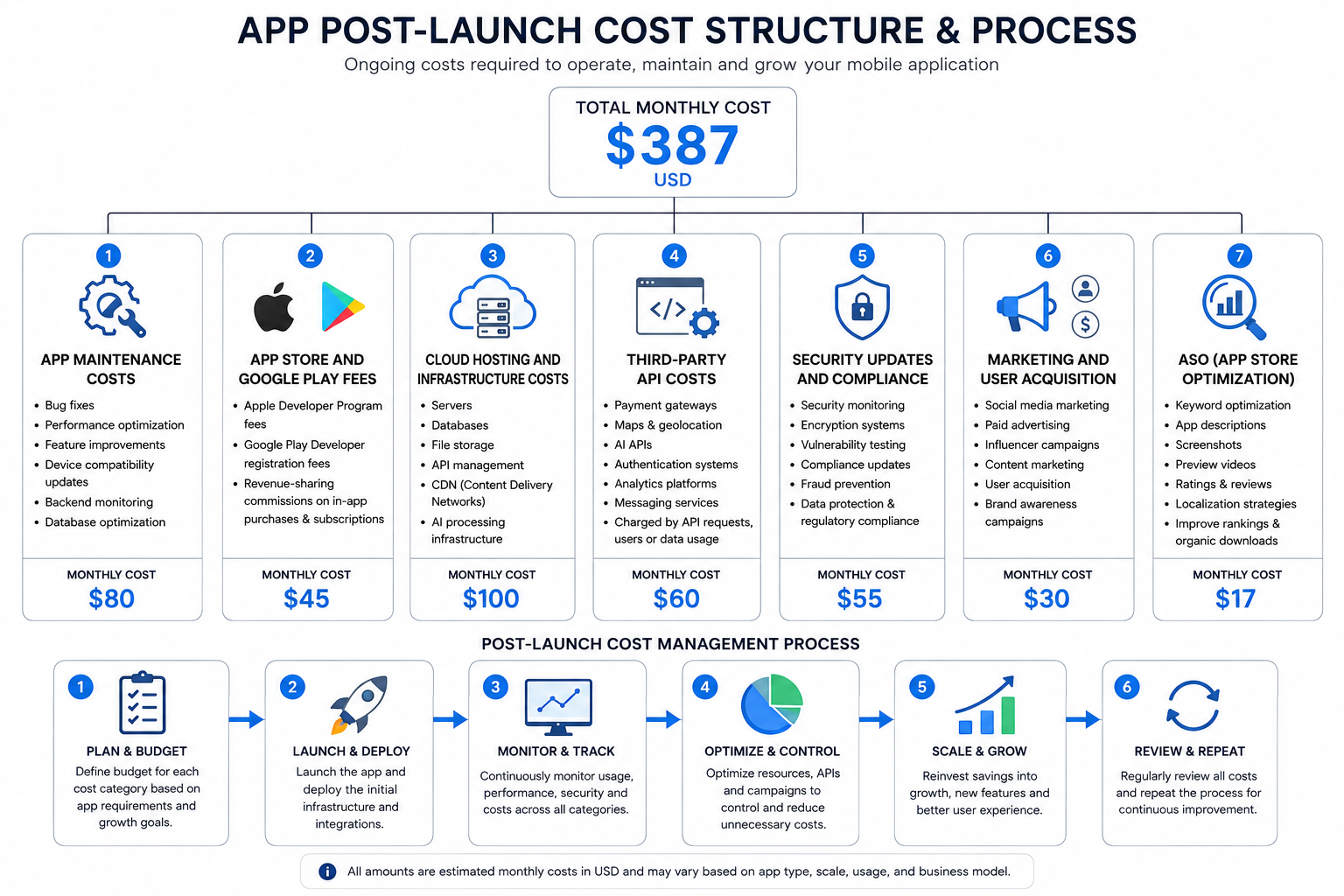
Hidden App Development Costs Businesses Often Forget
One of the biggest mistakes startups and businesses make in 2026 is assuming that app development ends after launch.
In reality, launching the app is only the beginning.
Many companies carefully calculate development expenses but completely underestimate the long-term operational costs required to maintain, secure, scale, and market the application successfully. This is one of the main reasons why many apps struggle financially after release.
A mobile app is not a one-time product — it is an ongoing digital ecosystem that requires continuous investment.
Industry estimates show that maintaining and scaling an app can cost 15–25% of the original development budget annually. For example, if an app costs $100,000 to build, businesses may spend an additional $15,000–$25,000 every year on maintenance, infrastructure, updates, and optimization.
For AI-powered or high-traffic applications, these costs can grow even faster.
Here are the hidden app development costs businesses frequently overlook.
a) App Maintenance
Every app requires regular maintenance after launch.
Operating systems like iOS and Android continuously release updates, security patches, and performance changes. If the application is not maintained properly, compatibility issues, crashes, and security vulnerabilities can quickly appear.
App maintenance typically includes:
- Bug fixes
- Performance optimization
- Feature improvements
- Device compatibility updates
- Backend monitoring
- Database optimization
For example, an e-commerce app handling thousands of transactions daily cannot afford downtime or payment failures. Even a small technical issue can directly impact customer trust and revenue.
In 2026, businesses that fail to prioritize app maintenance risk losing users to competitors with smoother and more reliable experiences.
b) App Store and Google Play Fees
Many startups forget that publishing apps on major platforms also involves recurring costs and platform commissions.
For example:
- Apple Developer Program fees
- Google Play developer registration fees
- Revenue-sharing commissions on in-app purchases and subscriptions
If your app includes subscriptions, digital products, or premium memberships, app store platforms may take a percentage of revenue from each transaction.
While these fees may appear small initially, they become significant as the app scales and generates larger volumes of transactions.
c) Cloud Hosting and Infrastructure Costs
Modern applications rely heavily on cloud infrastructure to support real-time functionality, data storage, and scalability.
Cloud hosting expenses often include:
- Servers
- Databases
- File storage
- API management
- Content delivery networks (CDNs)
- AI processing infrastructure
Platforms such as:
- AWS
- Firebase
- Azure
allow apps to scale globally, but they also introduce ongoing operational costs.
For example, a social media app processing millions of photos and videos requires significantly more storage and bandwidth than a simple informational app.
Similarly, AI-powered apps consume substantial cloud resources because machine learning models and AI APIs require high-performance computing power.
As user traffic grows, infrastructure expenses can increase dramatically.
d) Third-Party API Costs
Many modern apps depend on third-party APIs to provide advanced functionality quickly.
These integrations may include:
- Payment gateways
- Maps and geolocation services
- AI APIs
- Authentication systems
- Analytics platforms
- Messaging services
While APIs speed up development, most services charge recurring usage fees based on:
- API requests
- Monthly active users
- Data processing
- Storage usage
For example, an AI summarization app using external AI APIs may face rapidly increasing operational costs as user activity grows.
This becomes especially important for startups scaling quickly, because infrastructure and API expenses often rise faster than expected.
e) Security Updates and Compliance
Cybersecurity has become a major concern in app development in 2026.
As applications store more personal, financial, and behavioral data, businesses must invest continuously in:
- Security monitoring
- Encryption systems
- Vulnerability testing
- Compliance updates
- Fraud prevention
Industries such as healthcare, fintech, and enterprise SaaS require even higher security standards due to regulatory requirements and data protection laws.
A single security breach can lead to:
- Financial losses
- Legal consequences
- Reputation damage
- Loss of customer trust
That’s why modern businesses treat app security as an ongoing operational investment rather than a one-time setup.
f) Marketing and User Acquisition
Even the best app can fail if nobody discovers it.
One of the most underestimated post-launch expenses is marketing.
Businesses often spend heavily on development but allocate very little budget toward:
- Social media marketing
- Paid advertising
- Influencer campaigns
- Content marketing
- User acquisition
- Brand awareness campaigns
In today’s competitive app market, simply launching an app does not guarantee downloads or engagement.
Thousands of new apps enter app stores every week, making visibility a major challenge for startups.
This is why many successful companies now allocate significant portions of their budgets toward app promotion and customer acquisition strategies.
g) ASO (App Store Optimization):
App Store Optimization (ASO) has become essential for app growth in 2026.
ASO is the process of optimizing app store listings to improve visibility, rankings, and download conversion rates.
This includes:
- Keyword optimization
- App descriptions
- Screenshots
- Preview videos
- Ratings and reviews
- Localization strategies
Without proper ASO, even a high-quality application may struggle to rank in crowded app store search results.
For example, an app targeting keywords like:
- “AI productivity app”
- “cross-platform business app”
- “fitness tracking app”
must compete against thousands of alternatives.
Businesses increasingly invest in ASO specialists, creative assets, and conversion optimization to improve organic app discovery and reduce paid marketing costs.
The Reality of Long-Term App Costs
In 2026, app development is no longer a one-time expense.
The real challenge begins after launch — maintaining performance, scaling infrastructure, optimizing user acquisition, improving security, and continuously evolving the product to meet changing user expectations.
Businesses that plan only for initial development costs often struggle later because they underestimate the long-term investment required to keep an application competitive.
The most successful apps are not necessarily the ones launched with the biggest budgets — they are the ones built with long-term scalability, maintenance, and growth in mind from the very beginning
How to Reduce App Development Costs in 2026
Building a successful app in 2026 does not necessarily mean spending hundreds of thousands of dollars upfront.
The smartest businesses are no longer trying to build everything at once. Instead, they focus on strategic development decisions that reduce costs, shorten launch timelines, and minimize long-term risks.
With rising competition, AI integration, and increasing user expectations, companies must balance innovation with cost efficiency.
Here are the most effective ways businesses are reducing app development costs in 2026 without sacrificing quality or scalability.
Build an MVP First
One of the biggest reasons startups overspend is trying to launch a “perfect” app immediately.
Successful companies now focus on building a Minimum Viable Product (MVP) first — a simplified version of the app that includes only the core functionality needed to validate the idea.
Instead of spending $200,000+ upfront, businesses can often launch an MVP for a fraction of the cost and gather real-world feedback before scaling further.
An MVP typically focuses on:
- Core user functionality
- Essential business features
- Basic UI/UX
- Limited integrations
- Market validation
For example, instead of launching a full-scale food delivery platform with AI recommendations, loyalty systems, and advanced analytics, startups often begin with:
- User login
- Restaurant listings
- Basic ordering
- Payment integration
This approach dramatically reduces initial development costs while helping businesses identify what users actually want.
Many successful tech companies started this way before expanding into larger ecosystems.
Use Cross-Platform Development
Cross-platform development has become one of the biggest cost-saving strategies in modern app development.
Instead of building separate applications for iOS and Android, frameworks like:
- Flutter
- React Native
- .NET MAUI
allow developers to use a single shared codebase across multiple platforms.
This significantly reduces:
- Development time
- Engineering costs
- Maintenance expenses
- Testing workloads
- Update management
In many cases, cross-platform app development can reduce development time by 30–50% compared to fully native development.
For startups and growing businesses, this means:
- Faster product launches
- Lower development budgets
- Easier scalability
- Faster feature releases
Cross-platform frameworks have evolved dramatically in recent years, making them powerful enough for most modern business applications.
As a result, many companies now prioritize cross-platform development as a long-term cost optimization strategy.
Integrate AI Carefully
AI is one of the most exciting technologies in 2026, but it is also one of the fastest ways to inflate development budgets unnecessarily.
Many startups make the mistake of adding AI features simply because they are trending — not because they solve a real business problem.
AI integration becomes expensive due to:
- API costs
- Machine learning infrastructure
- Cloud GPU processing
- AI engineering
- Model training and optimization
Businesses should focus only on AI features that provide measurable value to users.
For example:
- AI summarization may improve productivity apps
- Recommendation systems may increase e-commerce conversions
- AI automation may reduce operational workload
However, adding unnecessary AI features can quickly increase both development and long-term infrastructure costs without improving user retention.
The smartest businesses use AI strategically rather than excessively.
Use Agile Development
Traditional development models often lead to larger budgets, delayed launches, and expensive revisions.
That’s why Agile development has become the preferred approach for modern app development teams.
Instead of building the entire application at once, Agile development focuses on:
- Smaller development cycles
- Incremental feature releases
- Continuous testing
- Faster feedback loops
- Flexible improvements
This allows businesses to:
- Identify problems earlier
- Reduce wasted development effort
- Improve budgeting accuracy
- Launch features faster
For example, instead of waiting 12 months to launch a complete app, companies can release smaller functional versions every few weeks or months and improve based on user behavior.
Agile development reduces risk significantly because businesses stay adaptable throughout the development process.
Prioritize UX from the Beginning
Poor user experience is one of the hidden reasons many apps fail after launch.
Companies often try to reduce costs by minimizing UI/UX investment, but this usually creates larger problems later.
A confusing interface leads to:
- Higher uninstall rates
- Lower engagement
- Reduced customer retention
- Increased support costs
In contrast, strong UX design improves:
- User satisfaction
- Retention rates
- Conversion rates
- Long-term profitability
Modern users expect:
- Smooth navigation
- Personalized experiences
- Fast loading times
- Intuitive design
- Accessibility support
Investing in quality UX early often reduces long-term costs because businesses spend less time fixing usability problems after launch.
In 2026, great design is no longer a luxury — it is a business necessity.
Trends Affecting App Development Costs in 2026
The app development industry is evolving rapidly, and several emerging trends are directly influencing development costs, timelines, and technology decisions.
Businesses planning digital products in 2026 must understand these trends because they are reshaping how modern applications are built.
AI-Native Applications
AI-native apps are becoming increasingly common across industries.
Instead of adding AI as an extra feature, many modern applications are now designed entirely around intelligent automation and personalization.
Examples include:
- AI productivity tools
- AI customer support platforms
- Smart recommendation systems
- AI-generated content apps
While AI-native applications create powerful user experiences, they also require larger budgets due to infrastructure, engineering, and cloud computing demands.
On-Device AI
Privacy concerns and performance optimization are driving the growth of on-device AI.
Instead of sending all user data to cloud servers, apps increasingly process AI tasks directly on smartphones and devices.
Benefits include:
- Faster response times
- Improved privacy
- Reduced cloud dependency
- Lower latency
However, implementing on-device AI often requires advanced optimization and specialized development expertise, which can increase upfront costs.
Cross-Platform Dominance
Cross-platform development is no longer viewed as a compromise.
Frameworks like Flutter and React Native are becoming dominant choices for startups and businesses aiming to reduce development costs and accelerate product launches.
As these technologies continue improving, more companies are shifting away from expensive dual native development strategies.
This trend is making app development more affordable and accessible for growing businesses.
No-Code and Low-Code Prototyping
No-code and low-code tools are transforming early-stage product development.
Businesses now use these platforms to:
- Validate ideas faster
- Build prototypes
- Test workflows
- Demonstrate concepts to investors
While enterprise-grade apps still require professional engineering, no-code prototyping helps reduce early research and development costs significantly.
Cloud-Native Architecture
Modern applications are increasingly built using cloud-native infrastructure.
Cloud-native development improves:
- Scalability
- Reliability
- Performance
- Global accessibility
Platforms like AWS, Azure, and Firebase allow apps to scale dynamically as user demand grows.
However, while cloud-native architecture improves flexibility, businesses must carefully manage recurring infrastructure expenses over time.
Accessibility Requirements
Accessibility is becoming a major focus in app development.
Modern apps are expected to support:
- Screen readers
- Voice navigation
- Larger text scaling
- Inclusive interfaces
- Improved usability for disabled users
Governments and platforms are also introducing stricter accessibility expectations, making accessibility-focused development increasingly important.
This adds additional design, testing, and compliance requirements during development.
Privacy-First Development
Data privacy is now one of the biggest concerns for users worldwide.
Businesses must increasingly prioritize:
- Secure authentication
- Data encryption
- User consent systems
- Privacy-focused architecture
Privacy-first development is becoming essential for user trust, especially in industries like healthcare, fintech, AI, and enterprise SaaS.
While stronger privacy measures improve brand credibility, they also increase backend complexity and security-related development costs.
Final Conclusion
App development in 2026 is more advanced, competitive, and opportunity-driven than ever before.
Businesses are no longer building simple applications — they are creating intelligent digital ecosystems powered by AI, cloud infrastructure, automation, and highly personalized user experiences.
But despite faster frameworks and smarter development tools, app development costs still depend heavily on:
- Project complexity
- Feature requirements
- Platform selection
- AI integration
- Infrastructure scalability
- Long-term maintenance needs
A simple MVP may cost between $15,000 and $50,000, while enterprise-grade AI platforms can easily exceed $500,000+depending on the scope and technical demands.
At the same time, modern strategies such as:
- Cross-platform development
- Agile workflows
- MVP-first approaches
- Strategic AI integration
are helping businesses reduce development costs while launching products faster than ever before.
For example, startups using cross-platform frameworks can often reduce development time by nearly 30–50%, while MVP-based launches help companies validate ideas before committing to large-scale investments.
The most successful businesses in 2026 are not necessarily the ones spending the most money — they are the ones making smarter technology decisions from the beginning.
Whether you are building:
- A startup MVP
- An e-commerce platform
- A SaaS product
- A healthcare solution
- An AI-powered application
Understanding the real cost of app development helps you plan strategically, avoid expensive mistakes, and invest confidently in scalable digital growth.
In today’s digital economy, building the right app is no longer just a technology decision — it is a long-term business investment that can define the future growth of your company.
Frequently Asked Questions (FAQs)
1. How much does it cost to build an app in 2026?
The cost of building an app in 2026 can range from $15,000 for a basic MVP to $500,000+ for enterprise-level or AI-powered applications. Pricing depends on app complexity, features, design quality, platform selection, backend infrastructure, and development team expertise.
2. What factors affect app development costs the most?
The biggest factors influencing app development costs include:
- App complexity
- Platform choice (iOS, Android, or cross-platform)
- UI/UX design
- AI integration
- Backend infrastructure
- Security requirements
- Third-party API integrations
- Scalability needs
3. Is cross-platform app development cheaper than native development?
Yes. Cross-platform development using frameworks like Flutter, React Native, or .NET MAUI can significantly reduce development costs because developers use a single codebase for both iOS and Android platforms. This approach can reduce development time by nearly 30–50%.
4. How much does it cost to build an AI-powered app?
AI-powered app development typically starts around $80,000 and can exceed $500,000+ depending on the complexity of AI features such as chatbots, recommendation systems, predictive analytics, automation, or image recognition.
5. What is the cheapest way to launch an app idea?
The most cost-effective strategy is building an MVP (Minimum Viable Product). An MVP focuses only on core features, allowing businesses to validate the idea, reduce risk, gather user feedback, and avoid overspending during the early stages.
6. How long does app development take in 2026?
Development timelines vary based on project complexity:
- Basic MVP apps: 2–4 months
- Medium-complexity apps: 4–8 months
- AI or enterprise applications: 8–18+ months
Timelines also depend on team size, feature scope, and testing requirements.
7. What are the hidden costs of app development?
Many businesses overlook long-term costs such as:
- App maintenance
- Cloud hosting
- API usage fees
- Security updates
- App Store and Google Play fees
- Marketing and user acquisition
- ASO (App Store Optimization)
These ongoing expenses can become a significant part of the total budget.
8. Is app maintenance necessary after launch?
Yes. Regular maintenance is essential to keep the app secure, compatible with operating system updates, bug-free, and optimized for performance. Most businesses spend approximately 15–25% of the original development cost annually on maintenance.
9. Which industries have the highest app development costs?
Industries such as:
- Healthcare
- Fintech
- Enterprise SaaS
- Social media
- AI platforms
typically have higher development costs due to security requirements, scalability demands, compliance regulations, and advanced functionality.
10. Why are AI features increasing app development costs?
AI features require:
- Machine learning infrastructure
- Cloud computing resources
- AI APIs
- Data processing systems
- Specialized AI engineers
These technologies increase both initial development and long-term operational costs.